SpaceX · Starlink Mobile · 11 Nov 2026
FCC accepts SpaceX’s 800 MHz applications for filing. Comments are due 1 Dec 2026
The Federal Communications Commission has accepted for filing SpaceX’s applications to take control of Grain Management’s nationwide 800 MHz licenses. That starts the formal review and opens a public comment window. Nothing has been approved yet, and the spectrum still belongs to Grain.
On this page
The editor holds Tesla and SpaceX shares. Supercharged Daily is independent and not affiliated with either company. Nothing here is financial advice.

What the FCC did
In Public Notice DA 26-1218, released 10 Nov 2026, the FCC’s Wireless Telecommunications Bureau said the applications were “acceptable for filing” after an initial review. They ask for consent to transfer control of 546 paired 800 MHz licenses. Under the purchase agreement, NewLevel IV, a Grain affiliate, would transfer its interests in two license companies, Prism License Co. 1 and Prism License Co. 2, to Starlink Spectrum Holdings, a wholly owned SpaceX subsidiary. Those two companies are the licensees of up to 14 MHz of paired 800 MHz spectrum in 173 economic areas, covering 3,224 counties across all 50 states, the District of Columbia, Puerto Rico and the U.S. Virgin Islands, and roughly 100% of the U.S. population.
The FCC says it can still send the applications back if it later finds them defective. Comments and petitions to deny are due 1 Dec 2026, oppositions 8 Dec 2026, and filings go in WT Docket 26-313. SpaceX also asked on 27 Oct 2026 for authority to use the same 800 MHz frequencies (817–824 MHz and 862–869 MHz) for supplemental coverage from space. The notice says that request is still pending.
How the deal got here
The FCC approved T-Mobile’s sale of this spectrum to Grain in a 1 July 2026 order. Grain announced a definitive agreement to sell the portfolio to SpaceX on 8 Oct 2026, and the companies filed with the FCC the next day. Neither side has disclosed a price. SpaceX says the low-band spectrum will provide “a coverage layer that ensures Starlink Mobile’s signal penetrates through obstacles, such as walls,” while its 2 GHz mid-band spectrum “will provide high-bandwidth capacity.”
We announced an agreement to acquire a nationwide low-band spectrum license portfolio that will pave the way for @Starlink to become a major mobile carrier in the US.
— SpaceX (@SpaceX) October 8, 2026
With this new spectrum and our Gen2 constellation, Starlink Mobile can ensure Americans have access to high-speed mobile broadband no matter where they are
Post: SpaceX (@SpaceX), 4:19 p.m. ET on 8 Oct 2026 (1:19 p.m. PT). Embedded from X via x-embed.js. The blockquote is the full post text (the original ends with a link to SpaceX’s updates page).
How much spectrum SpaceX would hold
According to the applicants, as restated in the notice, SpaceX would be attributed with up to 89 MHz of spectrum in each relevant area after the deal, including up to 14 MHz below 1 GHz. In its July order, the FCC said it takes a closer competitive look in markets where a company would hold about a third of the spectrum considered suitable and available for mobile broadband. That trigger was 385 MHz out of 1,123 MHz.
The same July order puts T-Mobile at 90 to 426 MHz after its swap with Grain, including 20 to 74 MHz below 1 GHz. So even at its stated maximum, SpaceX would have roughly a fifth of T-Mobile’s total, and of its low band, as those T-Mobile figures stood in the July order. The licenses reach every state, but a national carrier holds far more spectrum for carrying heavy traffic.
The deadlines that come with it
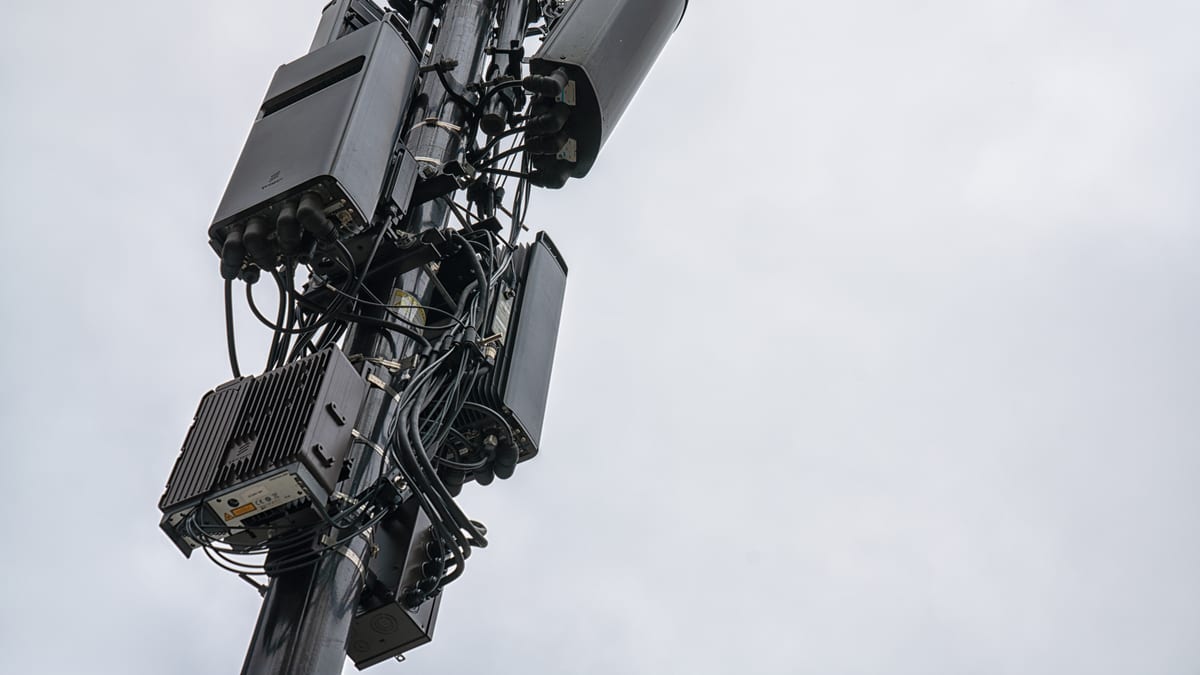
Grain’s licenses carry strict build-out conditions from the July order, and the November notice says those conditions would apply to SpaceX if the FCC approves the transfer. For terrestrial service, each license has to provide reliable signal coverage and service to 33% of its population (or 25% of its area) by 1 July 2029. By 1 July 2034, that rises to 66% of the population (or 50% of its area). A license that misses the final deadline ends automatically. SpaceX has said its 5G base stations will use Qualcomm chips, with deployment starting in 2027. That date is a company target, and we covered it in our base-stations piece.
When the deal was announced, Musk wrote: “To the casual observer, this won’t seem like much. To those who understand the spectrum wars, it’s an earthquake.” The notice gives no date for the FCC’s final decision.
@chamath To the casual observer, this won’t seem like much. To those who understand the spectrum wars, it’s an earthquake.
— Elon Musk (@elonmusk) October 8, 2026
Post: Elon Musk (@elonmusk), 5:31 p.m. ET on 8 Oct 2026 (2:31 p.m. PT), in reply to Chamath Palihapitiya. Embedded from X via x-embed.js. The blockquote is the full post text.
— Alex R
Sources: FCC Public Notice DA 26-1218 (10 Nov 2026) (PDF); FCC Order DA 26-653, T-Mobile/Grain (1 July 2026); FCC ECFS, WT Docket 26-313; Grain Management release (8 Oct 2026); SpaceX Updates (8 Oct 2026); @SpaceX on X (8 Oct 2026); @elonmusk on X (8 Oct 2026); @Starlink on X (4 Nov 2026). Related: SpaceX’s own 5G base stations; Starlink Mobile tower talks. Hero photo: Lance Cheung / U.S. Department of Agriculture, public domain, via Wikimedia Commons. Never Electrek.