Tesla · Long read · 29 Oct 2026
Tesla: The Plan. The complete story, 2003 to today
A garage-sized startup, a crushed GM car, a four-step plan Elon Musk told readers to keep secret, and the twenty years it took to carry it out.
On this page
The editor holds Tesla and SpaceX shares. Supercharged Daily is independent and not affiliated with either company. Nothing here is financial advice.
In August 2006, Elon Musk put Tesla's whole strategy on the company blog. It was short enough to fit on an index card, and he signed it off with three words: "Don't tell anyone."
Here is the plan, word for word:
"Build sports car. Use that money to build an affordable car. Use that money to build an even more affordable car. While doing above, also provide zero emission electric power generation options."
Twenty years later, Tesla has built all of those things. It has also built factories on three continents, a charging plug the rest of the US car industry now uses, a fleet of cars with no steering wheel, and a humanoid robot it says it will make by the million. Along the way it came within weeks of running out of money, sued and was sued by its own founders, took a federal loan that critics called a bailout, spent a year in what its CEO called "production hell", paid a $20 million penalty over a single tweet, and watched its showrooms get set on fire.
This is the whole story, in order. It starts before Musk, with two engineers and a car General Motors decided to crush.
Part one: before Tesla
The car GM crushed
In 1996 General Motors started building an electric car called the EV1. It was a two-door, two-seat coupe, and it was the first attempt by a big American carmaker at an electric car designed from scratch and built in volume. GM made it from 1996 to 1999.
The EV1 existed because of a rule. California's air regulators had told the seven biggest carmakers selling in the US that they had to produce and sell zero-emission vehicles to keep access to the California market. GM didn't sell the EV1. It leased it, mostly to drivers in California, Arizona and Georgia, and later in other states. The people who leased it tended to love it.
GM had decided electric cars were an unprofitable niche. In 2003 it ended the program, over protests from the people driving them. It took the cars back and sent most of them to be crushed. It gave one working EV1 to the Smithsonian, which had turned down a disabled one. By 2003 the EV1 had become a symbol for electric car fans: proof that a big carmaker could build one and would still choose not to.
That is the backdrop for everything that followed. The big companies had looked at electric cars and decided they were a compliance exercise. Nobody expected a startup to do better.
The tzero
Martin Eberhard and Marc Tarpenning were not car people. They were Silicon Valley engineers. In 1996 they founded NuvoMedia, which in 1998 released one of the first dedicated e-book readers, the Rocket eBook. It held up to ten books and sold for $499. In 2000 Gemstar-TV Guide International bought NuvoMedia for $187 million.
Eberhard liked sports cars and worried about oil imports and global warming, so he started looking at electric cars. Sourcing lithium-ion cells for the Rocket eBook had taught him something about batteries, too.
He found a small Southern California firm called AC Propulsion. It had hand-built an electric sports car in the mid-1990s called the tzero. Eberhard tried to buy one and contacted Tom Gage, who had built it. Gage was converting the car to lithium-ion cells like the ones in laptop computers. Eberhard put some money and technical help into that work. The conversion ran from March to September 2003 and gave the tzero a range of 300 miles.
Eberhard came away convinced that an electric car didn't have to be a sensible little box. Tesla's own history credits the tzero as the inspiration for its first car.
The lithium-ion cell was the key. Laptop batteries were getting cheaper and better every year because of consumer electronics. If you could wire enough of them together, safely, you could get range and performance that the lead-acid and nickel batteries of earlier electric cars never offered.
Part two: two engineers and a plan
Tesla Motors is born
Tesla Motors was incorporated on 1 Jul 2003, by Eberhard and Tarpenning in San Carlos, California. They named it after Nikola Tesla, the inventor whose work on alternating current underpins the induction motor. Eberhard was CEO and Tarpenning was CFO. Eberhard said he wanted to build "a car manufacturer that is also a technology company", with the battery, the software and the motor as its core technologies.
Their plan was to start at the top of the market. A sports car could carry a high price, and early buyers of new technology tend to pay more. The money would then fund cheaper cars. It is the same logic Musk would later put in writing.
Ian Wright joined as the third employee.
Enter Musk
Elon Musk had sold his share of PayPal to eBay in 2002 and had already started SpaceX. In February 2004 Tesla raised $7.5 million in its first funding round. Musk put in $6.5 million of it and became chairman of the board. JB Straubel, an engineer who had been building electric vehicles on his own and who went on to lead Tesla's battery and powertrain work, joined in May 2004.
At this stage Musk was the lead investor and chairman, not the boss. Eberhard was CEO. Musk was closely involved in the product, especially the design of the car, and he kept putting money in as the company raised further rounds.
Who founded Tesla?
That question became a lawsuit. In 2009 Eberhard sued Musk, partly over Musk describing himself as a founder. They settled. Under the 2009 settlement, five people can call themselves co-founders of Tesla: Eberhard, Tarpenning, Wright, Straubel and Musk.
It sounds like a footnote. It still comes up whenever someone argues about who "made" Tesla, and the honest answer is that the company was started by Eberhard and Tarpenning and saved, financed and then run by Musk.
Part three: the Roadster and the money pit
A Lotus with a laptop battery
Tesla didn't try to build a whole car from scratch at first. On 11 Jul 2005, it signed a deal with the British sports car maker Lotus. Lotus would advise on design and supply partly built cars, or "gliders", based on its Elise, and Tesla would fit its own battery and motor. The contract covered 2,500 gliders.
In August 2006, Musk published the "Secret Tesla Motors Master Plan" on the company blog. It spelled out the sports-car-first strategy and ended with that line asking readers to keep it between themselves.
The Roadster prototype was unveiled on 19 Jul 2006, at an event for about 350 guests in a hangar in Santa Monica. Tesla offered test rides. People liked it, and reservations came in, including from Hollywood names.
Harder to build than to show
Building it was a different matter. The car's two-speed transmission kept failing. Costs rose well above plan, and the company kept changing parts of the design, which made things worse. A car that started as a modified Lotus ended up sharing only about 6% of its parts with the Elise. Its body panels were carbon fiber, to save weight.
In August 2007 the board asked Eberhard to step down as CEO. He moved into a different role and then left. By January 2008 both he and Tarpenning were gone from the company they had founded. Tesla went through interim chief executives while the Roadster problems dragged on.
The first production Roadster was handed to Musk in February 2008. It was the first highway-legal, series-production electric car to use lithium-ion battery cells, and the first production electric car to go more than 200 miles on a charge. Depending on the version it did 0 to 60 mph in 3.7 or 3.9 seconds, with a top speed of 125 mph.
Tesla stopped taking US orders in August 2011 and built the last Roadsters in January 2012, when its supply of Lotus gliders ran out.
2008
Then the financial crisis hit. Tesla was burning cash on a car it was selling at a loss, while banks and investors everywhere were pulling back. A car blog, The Truth About Cars, started a running "Tesla Death Watch" in May 2008.
Musk's other company was in trouble too. SpaceX's first three Falcon 1 rockets had failed. Musk later said the fourth launch was "the last money that we had for Falcon 1", and that if it had failed, "that would have been it for SpaceX." On 28 Sep 2008, it reached orbit, the first privately developed liquid-fueled rocket to do so.
Tesla had no such moment. In October 2008 Musk took over as CEO and cut about a quarter of the staff. In December 2008 Tesla closed a $40 million debt round that kept it alive.
By January 2009 Tesla had raised $187 million in total and delivered just 147 cars. Musk had put in $70 million of his own money.
Six years after it was incorporated, Tesla had shipped fewer cars than a mid-sized dealer sells in a quarter. It had lost its founding CEO and its CFO, and the people who had placed early orders were waiting on a car that cost more to build than they had paid. The only reason it still existed was that its chairman kept writing checks.
Part four: the rescue
Daimler
The first lifeline came from an old-line carmaker. Daimler, the maker of Mercedes-Benz, had started working with Tesla in late 2007. On 19 May 2009, it bought a stake of just under 10% for a reported $50 million, and a Daimler executive, Herbert Kohler, took a seat on Tesla's board. Musk has said the Daimler money saved Tesla.
The tie-up was practical as well as financial. Daimler's Smart division built electric Smart cars from 2009 to 2012 using a lithium-ion battery from Tesla. In July 2009 Daimler sold 40% of its new stake to Aabar, an investment company controlled by Abu Dhabi's government.
The Department of Energy loan
The second came from Washington. In June 2009 the US Department of Energy approved a $465 million low-interest loan to Tesla, under a program set up to help carmakers build more fuel-efficient vehicles in the US. The money was mainly for the Model S and a powertrain plant in California.
The timing mattered as much as the size. In 2009 the US car industry was in crisis, and GM and Chrysler were going through bankruptcy. A startup with one car on sale was asking the government for money while two of the big three were being restructured.
Critics called it a bailout. Tesla paid it back in May 2013, nine years early, with about $12 million in interest. It was the first carmaker in the program to repay its loan in full.
The first profit
In July 2009 Tesla had its first profitable month: about $1 million of profit on about $20 million of revenue, from 109 cars delivered. One good month didn't make it a healthy company, but it showed the Roadster could pay its way at scale.
Tesla ended up selling about 2,450 Roadsters in more than 30 countries before production ended. That was step one of the plan. It had cost far more than anyone expected, but the sports car existed and people had bought it.
Part five: going public
A factory Toyota didn't want
To build the next car, Tesla needed a factory, and it found one cheaply. NUMMI, in Fremont, California, had been a joint venture between Toyota and GM. When GM went through bankruptcy in 2009 it pulled out, and Toyota closed the plant in 2010.
In May 2010 Tesla agreed to buy part of the site from Toyota for $42 million. As part of the deal, Toyota also invested $50 million in Tesla. In July 2010 the two companies said they would build a second-generation RAV4 EV together. It went on sale in 2012 with a battery pack, electronics and powertrain parts from the Model S. Just under 3,000 were built before it ended in 2014.
In October 2014 Daimler and Toyota both sold their Tesla shares, together making a profit of more than $1 billion. In 2017 Toyota said it had sold all of its remaining Tesla stock and ended the partnership.
That factory, a plant big enough for hundreds of thousands of cars a year bought for the price of a few office buildings, is still Tesla's main US car plant.
The IPO
On 29 Jun 2010, Tesla listed on the Nasdaq under the ticker TSLA. It sold 13.3 million shares at $17 each and raised $226 million. It was the first American carmaker to go public since Ford in 1956.
Tesla had never made an annual profit, had one car on sale, and was about to stop building it. Investors bought the story anyway.
That $17 share works out to about $1.13 today, after later stock splits. Keep that number in mind for the end of this story.
Part six: the Model S
Step two
The Model S was the second step of the plan: a full-size, five-seat sedan with a big battery under the floor and a large touchscreen in place of most buttons. Tesla designed it in-house, under chief designer Franz von Holzhausen. He had worked at Volkswagen and General Motors and had been design director at Mazda from 2005. It was built in Fremont.
Tesla handed over the first production Model S cars at an event at the factory on 22 Jun 2012. The battery sat flat under the floor, which kept the center of gravity low and left room for a front trunk where the engine would usually be. The 17-inch touchscreen ran almost everything, from the climate to the sunroof. The reviews were glowing. Motor Trend judges voted it their 2013 Car of the Year, unanimously.
The car also kept getting better after people bought it. Tesla could send software updates over the air, adding features or changing how the car drove overnight, the way a phone gets updates. Most carmakers at the time needed a dealer visit to change anything.
Free charging across the country
One problem remained. People didn't want an electric car they couldn't take on a road trip. On 24 Sep 2012, Tesla switched on its own fast-charging network, the Superchargers: six stations in California linking Los Angeles, San Francisco, Lake Tahoe and Las Vegas. Model S owners with the right battery could charge there for free.
Six stations became a few hundred, then thousands.
The hardware kept getting faster. Compact "Urban" posts arrived in September 2017 for city car parks. V3 stations, introduced in 2019, could deliver up to 250 kW. In September 2025 Tesla began deploying a V4 cabinet able to deliver up to 500 kW to cars with 800-volt systems. As of the end of September 2026, Tesla reported 8,904 Supercharger stations and 84,465 connectors worldwide. That network would later shape the whole US industry.
Near-misses
The Model S wasn't an easy win. In early 2013 Tesla was again short of cash. Musk proposed an $11 billion deal for Google to buy Tesla. Instead, a hard sales push turned orders into deliveries, the stock took off, and the deal never happened.
Later in 2013, several Model S cars caught fire after road debris punctured the battery pack. The stock fell more than 20%. In 2014 Tesla added a titanium plate under the battery. Despite the drop, Tesla was still the best performer on the Nasdaq 100 in 2013.
The car kept changing. In 2014 Tesla replaced its top P85 with the P85D. The "D" meant dual motor: a second motor up front gave all-wheel drive and a combined 691 horsepower. A family sedan with that output was new.
Growing up, slowly
Tesla grew in fits and starts in these years. It raised money almost every year: $2 billion in bonds in February 2014 to build the Nevada battery plant, $738 million in stock in August 2015 for the Model X, more again in 2016. By 2014 the company that had listed in 2010 was worth half as much as Ford.
The sales targets kept slipping. Tesla wanted to sell 40,000 cars in 2014, adding China, Hong Kong, Japan and Australia as export markets, and cut that to 33,000 in November. In the third quarter of 2015 it built a record 13,091 cars, and it guided to 50,000 to 52,000 for that year.
It sold cars differently from everyone else, too. Instead of franchised dealers, Tesla ran its own stores and "galleries", often in shopping malls. By October 2016 it had about 260 in the US, and that June it opened a small store inside a Nordstrom at The Grove in Los Angeles. In May 2015 it started selling refurbished used Model S cars directly. In 2015 it bought Riviera Tool & Die, a Michigan stamping supplier with about 100 workers.
It was also not yet the biggest. In 2016 BYD sold 101,183 plug-in cars worldwide and Tesla 76,243. On 26 Oct 2016, Tesla reported its first profitable quarter in two years.
Part seven: Model X and SolarCity
The falcon-wing doors
The Model X SUV arrived on 29 Sep 2015, years after it was first shown. Its "falcon wing" rear doors hinged in the middle and lifted upward. They looked great on stage and were very hard to build. Tesla had first said Model X production would start in 2014. It pushed that to the second quarter of 2015, then to the third. The doors were one reason. Cooling the motors while towing was another. In 2016 Tesla sued the Swiss hydraulics firm Hoerbiger, which supplied parts for the doors, saying they leaked oil and overheated. The case settled that September.
Batteries for houses
The plan also promised "zero emission electric power generation options". On 30 Apr 2015, Tesla said it would use its battery technology in a home energy storage system called the Powerwall. Owners could store solar power for the evening or keep the lights on in an outage. The first Powerwall was built in small numbers. Powerwall 2 went into mass production in early 2017 at Tesla's Nevada battery plant. For utilities, Tesla sold a 200 kilowatt-hour Powerpack, used at the Hornsdale Power Reserve in South Australia, and in July 2019 it launched the Megapack. Each Megapack is about the size of a shipping container and can store up to 3.9 megawatt-hours.
SolarCity
In 2016 Tesla bought the solar installer SolarCity in an all-stock deal worth $2.6 billion. SolarCity had been founded on 4 Jul 2006, by Musk's cousins Peter and Lyndon Rive, from an idea Musk suggested, and Musk was its chairman. It was short of cash at the time, and Tesla shareholders weren't told. Some investors called the deal "a misguided effort to rescue two companies that depend on investors and the government for operating cash."
Shareholders sued Musk. In April 2022 a Delaware judge, Joseph Slights, ruled in his favour, writing that "Tesla paid a fair price". The Delaware Supreme Court upheld that ruling on 6 Jun 2023.
Musk's defence was that the deal completed the plan: solar panels on the roof, a battery in the garage, and an electric car in the driveway. In February 2017 the company dropped "Motors" from its name and became Tesla, Inc.
The Gigafactory
Batteries were the most expensive part of any electric car. To bring the cost down, Tesla planned a huge battery plant with Panasonic as its cell partner. In July 2014 Panasonic agreed in principle to invest in a factory estimated to cost $5 billion. On 4 Sep 2014, Tesla and Nevada officials announced the site, outside Reno. Panasonic would make the cells. When the Model 3 reservation numbers came in, in April 2016, Panasonic moved its plans forward and announced a $3.86 billion bond sale, mostly to fund the plant. It called the plant the Gigafactory. The name stuck, and every big Tesla plant since has been a "Giga" something.
Part eight: production hell
325,000 deposits
Step three was the "affordable car". On 31 Mar 2016, Tesla unveiled the Model 3, a smaller sedan. Reservations opened that day, with a refundable $1,000 deposit, and people queued outside stores before they had seen the car. Tesla said more than 115,000 people had reserved one in the 24 hours before the unveiling. Two days later it had 232,000. After a week it had more than 325,000, worth over $14 billion in potential sales. The previous record for advance deposits on a car was the 1955 Citroën DS, with 80,000 over ten days at the Paris show.
In May 2016 Tesla sold $2 billion of new shares to pay for faster production. It also pulled its target of 500,000 cars a year forward by two years, to 2018. By August 2017 it had 455,000 net reservations.
Investors were nervous about whether Tesla could deliver, and about competition, as Volvo committed to offer only electric and hybrid models from 2019. In 2016 Musk had predicted 100,000 Model 3s would be sold in 2017, while warning that production might only reach 20,000 by December.
That was a vote of confidence and a huge problem. Tesla had sold fewer than 110,000 Model S sedans in total by the end of 2015. Now it had to build hundreds of thousands, at a lower price, at a profit.
260 cars
Production began in July 2017. Tesla itself had warned of "production bottlenecks" and "production hell". Tesla had told investors it would make 1,500 Model 3s in the third quarter. It made 260.
The factory had been designed with a very high level of automation, and much of it didn't work. In November 2017, Bloomberg calculated that Tesla had been burning through about $8,000 a minute over the previous twelve months.
Sleeping at the factory
Musk took over the Model 3 line himself and called the period "production hell". In April 2018 he showed CBS This Morning the conference-room couch he'd been sleeping on. "When things get really intense, I don't have time to go home and shower and change, so I just sleep here," he said. Last time, he added, he had slept on the floor because the couch was too narrow.
The same day he admitted on Twitter that the robots were part of the problem. "Yes, excessive automation at Tesla was a mistake," he wrote. "To be precise, my mistake. Humans are underrated."
The tent
The fix was improvised. Tesla put up a huge tent in the Fremont parking lot and built a new assembly line under it, using more people and fewer robots. In the last week of June 2018, Tesla hit its goal of 5,000 Model 3s in a single week.
Part nine: funding secured
The tweet
A month later Musk posted one of the most expensive tweets ever written. On 7 Aug 2018, he wrote: "Am considering taking Tesla private at $420. Funding secured."
The stock jumped. There was no signed deal. Musk said he had felt confident because of talks with the managing director of Saudi Arabia's sovereign wealth fund, who had asked him to consider taking Tesla private. On 24 Aug 2018, Musk said Tesla would stay public.
The SEC
The Securities and Exchange Commission sued Musk for securities fraud in September 2018. Two days later, he settled. Musk and Tesla each paid a $20 million penalty. Musk had to give up the chairman's role for three years, though he stayed as CEO. Tesla had to add independent directors and put in place controls on his communications.
Investors had been asking for a more independent board for a while. The board at the time included Musk's brother Kimbal and several directors who had also invested in SpaceX. When a group of investors wrote asking for change, Musk first replied on Twitter that they "should buy Ford stock" because "their governance is amazing." Two days later he promised two new independent directors. Kathleen Wilson-Thompson and Larry Ellison joined at the end of 2018.
Shareholders also sued. In February 2023 a California jury unanimously found Musk and Tesla not liable in that class action.
Step three, done
In the middle of all that, the Model 3 started selling in big numbers. By the end of 2018 it was the best-selling plug-in car in the world, and Tesla delivered 245,240 cars that year. In 2019 deliveries rose another 50%, to about 367,500. From July 2019 to June 2020 Tesla had four profitable quarters in a row for the first time, which made it eligible for the S&P 500.
The $35,000 Model 3 took longer. Tesla announced a Standard Range version at that price on 28 Feb 2019. Six weeks later it said the car could only be ordered by phone or in stores, not online.
The three steps of the 2006 plan were complete. To sell an affordable car worldwide, though, Tesla needed something it had never built from scratch: a car factory of its own.
Part ten: the Gigafactories
Shanghai in less than a year
Tesla signed its Shanghai deal in July 2018, in the middle of production hell. It was unusual. The factory would be wholly owned by Tesla, not a joint venture with a Chinese partner, the first time China had allowed that for a foreign carmaker.
The terms were generous. Tesla owns the factory but not the land, which is normal in China. It got land-use rights for an initial 50 years, about $521 million in loans from Chinese banks at favorable rates and $82 million in grants. In return it agreed to invest at least 14 billion yuan, about $2 billion, by the end of 2023, and to generate 2.23 billion yuan a year in tax revenue from then on.
Tesla broke ground on 7 Jan 2019. Production started that October. On 30 Dec 2019, the first 15 cars built there were handed over to Tesla employees, and customer deliveries began in early January 2020. Bare land to finished cars took less than a year. The land deal itself had moved quickly. Pudong's planning office issued the compulsory purchase order on 8 Aug 2018, and the purchase was due to be final on August 20.
By November 2021 the plant's capacity was estimated at close to 700,000 cars a year, making it Tesla's biggest factory. It also became an export hub for Asia and Europe.
Berlin and Texas
More followed. Gigafactory Berlin opened on 22 Mar 2022, with planned capacity for 500,000 cars a year. Musk had announced it on 12 Nov 2019, at a German car awards show. Site preparation started in early 2020, and the clearing crews found old ordnance; seven bombs were detonated in a controlled explosion in January 2020. Production was meant to start in July 2021, but permits held it up. Water was a long-running local issue: the existing supply covered the first phase of about a quarter of a million cars, but the later phases needed more. Gigafactory Texas, outside Austin, started building Model Ys in April 2022. Tesla picked the site, about 2,100 acres near Del Valle, east of Austin, in July 2020, after Tulsa, Oklahoma, had campaigned hard for it. The local school district approved a tax incentive package worth $68 million and the state about $50 million more. Tesla announced the choice on its second-quarter earnings call on 22 Jul 2020, and construction started within days. The road along the site was later renamed Tesla Road. Deliveries of the first Texas-built cars took place at an opening party called "Cyber Rodeo" on 7 Apr 2022. It is now the main factory for the Cybertruck and the Cybercab, and Musk has called it the biggest factory in the United States. Tesla had already moved its headquarters from California to Texas in December 2021. It didn't leave California behind. It kept using its old Palo Alto headquarters, opened the Lathrop Megafactory in 2022, and said in February 2023 it would put a global engineering headquarters in Palo Alto, on a campus once owned by Hewlett Packard. In March 2023 it announced a Gigafactory in Mexico, meant to open in 2025. Its groundbreaking has been delayed.
Part eleven: the car that outsold the Corolla
Model Y
The Model Y was the fourth step nobody wrote down. It was a compact SUV built on the Model 3 platform, sharing about three-quarters of its parts. Production started at Fremont in January 2020.
It changed how cars are built, too. In August 2020 Tesla began installing what it called the Giga Press, then the world's biggest casting machine. It cast the whole rear of the Model Y body in one large piece of aluminum. Tesla said the process replaced 70 different metal parts. Fewer parts meant fewer robots, fewer joints and a simpler line. The Model Y also shared about three-quarters of its parts with the Model 3, so Tesla could build both on the same supply chain. Unlike the Model X, it had ordinary rear doors. Musk confirmed that in March 2019, a few days before the unveiling. Rival carmakers spent the next few years studying and copying "gigacasting".
Number one
In 2023 Tesla delivered 1.2 million Model Ys. It was the best-selling vehicle in the world that year, ahead of the Toyota Corolla. No electric car had held that title before.
Tesla kept updating its two volume cars rather than replacing them. A refreshed Model 3, codenamed "Highland", was announced on 1 Sep 2023. Tesla said half its components had changed. It had a quieter cabin, a softer ride, a small rear screen and no stalks on the steering column. A refreshed Model Y followed in January 2025, and in mid-2025 Tesla added the Model Y L, a longer six-seat version.
The Model Y almost wasn't built in Fremont at all. At its March 2019 unveiling Tesla expected to make it at the Nevada plant. By May 2019 it had decided to rearrange the Fremont lines instead.
On 9 Mar 2020, Tesla had built its millionth electric car, the first carmaker to get there. In 2023 it delivered about 1.8 million cars in total.
The plug everyone uses
The bigger change was in what the rest of the industry did. Electric cars stopped being a side project for most carmakers and became the plan.
The clearest sign was the plug. In November 2022 Tesla opened up the design of its own charging connector and called it the North American Charging Standard, or NACS. In May 2023 Ford became the first big carmaker to say it would switch. Others followed fast. In June 2023 SAE International said it would make the connector an official standard, SAE J3400. Between May 2023 and February 2024, most major automakers committed to NACS for North America, and many of their drivers gained access to Superchargers.
For a while Tesla tried to serve both plugs. In February 2023 it began fitting a "Magic Dock" adapter at some V3 Supercharger sites so cars with the rival CCS1 plug could charge. Once the industry moved, there was little need. SAE finalized J3400 in September 2024, and fewer than 100 V3 sites ever got the dock.
The battery side moved too. At Battery Day in September 2020, Tesla announced its own larger "4680" cell, which it later built at Gigafactory Texas.
Part twelve: a trillion dollars
The most valuable carmaker
On 10 Jan 2020, Tesla became the most valuable American carmaker ever, worth $86 billion. On 1 Jul 2020, it passed Toyota, at $206 billion, to become the most valuable carmaker in the world. It split its stock 5-for-1 on 31 Aug 2020, and joined the S&P 500 on 21 Dec 2020. Over 2020 the shares rose about 743%.
On 25 Oct 2021, Hertz announced an order for 100,000 Teslas for its rental fleet. The stock jumped and Tesla's market value passed $1 trillion for the first time. It was only the sixth US company to get there. That first spell lasted from October 2021 to March 2022.
It didn't stay there. The shares split again, 3-for-1, in August 2022. By 3 Jan 2023, they closed at $108.10, adjusted for splits, down from $409.97 in November 2021.
The pay package
In 2018 Tesla's board had given Musk a pay package of stock options that only vested if Tesla hit huge market value and operating targets. A shareholder named Richard Tornetta, who owned nine shares, sued that year. In January 2024 Delaware Chancellor Kathaleen McCormick voided the package, by then valued at about $55 billion, ruling that the shareholder vote had been based on misleading information and that the pay was unfair. In June 2024 Tesla shareholders approved it again with about 77% support, and the company moved its incorporation from Delaware to Texas. McCormick reaffirmed her ruling in December 2024.
Part thirteen: Autopilot to Full Self-Driving
Autopilot
Tesla started selling Autopilot, its driver-assistance system, in October 2014. In 2015 it cost $2,500 on a Model S. In 2016 Tesla split it into Enhanced Autopilot for $5,000 and a $3,000 Full Self-Driving add-on. In April 2019 basic Autopilot became standard on every Tesla. FSD cost $5,000 then, $10,000 from October 2020 and $15,000 from September 2022. As the price rose, the share of buyers taking it fell, from an estimated 37% in 2019 to 12% in 2021. In March 2019 Tesla moved new cars to Hardware 3, its own self-driving computer. The first version was built with the Israeli chip company Mobileye. Mobileye ended the partnership in July 2016, saying Tesla "was pushing the envelope in terms of safety". Tesla moved to its own hardware and then its own chips.
Autopilot drew scrutiny from the start. Crashes involving cars with the system engaged led to investigations by the National Highway Traffic Safety Administration and the National Transportation Safety Board, and to lawsuits. Tesla has always said the driver must stay attentive and that the system makes driving safer.
A million robotaxis
In April 2019, at an investor event called Autonomy Day, Musk said he felt "very confident predicting autonomous robotaxis for Tesla next year". He talked about a million robotaxis on the road by 2020. That didn't happen. He said the cars would be "feature-complete on full self-driving" by the end of 2019 and would not need anyone watching them by the second quarter of 2020. He said owners who put their cars on the network would see costs under 20 cents a mile, against $2 to $3 a mile for a ride-hailing service with a driver.
The idea was older than that. In 2016 Musk had talked about a shared fleet in which a Tesla could earn money for its owner while the owner was at work, and said every new Tesla was being built with the hardware for "full self-driving capability." In 2018 he said the network would compete directly with Uber and Lyft.
What did arrive, in October 2020, was a "beta" of Full Self-Driving for a small group of US owners. It reached every North American buyer of the option in November 2022. In February 2023 Tesla recalled 362,758 cars with the beta, through a software update, after regulators raised concerns about how it behaved at intersections.
End to end
The big change came with version 12. In August 2023 Musk livestreamed a 45-minute drive on an early build. Tesla said v12 was "end-to-end": a neural network trained on video that takes camera images in and puts driving decisions out. The release notes said more than 300,000 lines of hand-written C++ code had been removed.
In April 2024 version 12.3.3 dropped the word "beta" for "Supervised". Tesla said owners had driven more than a billion miles on it. By January 2025 the figure was three billion. Version 13, in late 2024, was built for Tesla's newer AI4 computer.
The same year brought cutbacks. In April 2024 Tesla said it would lay off 10% of its employees. In October it showed concept versions of the Cybercab and a larger Robovan, as the vehicles for a ride-hailing service it had first talked about in 2019.
Part fourteen: Cybertruck and Semi
The window
On 21 Nov 2019, Musk unveiled the Cybertruck in Los Angeles. It looked like nothing else on the road: flat stainless-steel panels and sharp angles. Tesla said its "Armor Glass" was close to unbreakable. Designer Franz von Holzhausen threw a metal ball at the driver's window. It shattered. He threw another at the rear passenger window. That shattered too.
People put down $100 deposits anyway, in huge numbers. Five days after the unveiling, Musk said there were 250,000 preorders. Deliveries began on 30 Nov 2023, at Gigafactory Texas, four years after the reveal. The prices had moved a long way. At launch, the dual-motor version was listed at $79,990 and the three-motor "Cyberbeast" at $99,990, between $21,000 and $39,000 more than the 2019 projections. By August 2024 the truck was readily available and Tesla closed reservations. Stainless steel, a new electrical system and a very different body made it one of the hardest vehicles Tesla had built.
The Semi
Tesla had also unveiled an electric heavy truck, the Semi, in November 2017, at the same event where a new Roadster rolled out of the back of a trailer. Musk claimed it would cost 20 cents a mile less to run than a diesel truck and predicted production in 2019. Production started in October 2022, and on 1 Dec 2022, at an evening event at the Nevada plant, Tesla handed the first Semis to PepsiCo for its Pepsi and Frito-Lay fleets. Production then stalled.
Part fifteen: 2025, the backlash
Protests and attacks
In early 2025 Tesla became the target of protests aimed at its CEO. A campaign called Tesla Takedown urged people to sell their Teslas and Tesla shares and held protests outside showrooms. On 29 Mar 2025, organisers said protests took place in more than 250 cities.
Some people went much further. In early March, a dozen Teslas were set on fire at a dealership in Plaisance-du-Touch, near Toulouse, France. On March 3, Tesla chargers were set alight in Littleton, Massachusetts. In Loveland, Colorado, a person was arrested after a Molotov cocktail was thrown at a dealership. Shots were fired at a showroom in Tigard, Oregon, twice in a week. On March 18, several Teslas were burned at a Tesla collision centre near Las Vegas, and a local man was charged with federal offences. Cybertrucks were set on fire at a dealership in Kansas City.
Musk told those responsible to "stop being psycho" and called Tesla a "peaceful company".
The sales drop
The damage showed up in the numbers. Tesla's sales in the EU and UK fell by nearly half in January 2025, and its shares dropped more than 9% on the news. In April, its European sales were down 49% on a year earlier, to 7,261 cars. First-quarter deliveries worldwide came in at 336,681, down 13%.
Brand damage was not the only cause. Tesla's line-up was aging, and it was losing ground to new competition, especially from Chinese carmakers such as BYD.
The stock, which closed at $479.86 on 17 Dec 2024, closed at $221.86 on 8 Apr 2025, a fall of 54% in under four months.
For the full year 2025 Tesla delivered 1,636,129 cars, down about 8.6% on 2024, the second straight annual decline. In January 2026 the final figures showed BYD had sold 2,256,714 battery electric cars. For the first time in years, Tesla was no longer the world's biggest maker of electric cars.
Its answer was a car with no steering wheel.
Part sixteen: robotaxi
The first ride
Tesla's Robotaxi service opened in Austin, Texas, on 22 Jun 2025. It was small: modified Model Ys, a fenced-off part of the city, invited riders, and a Tesla employee in the passenger seat as a safety monitor.
It was watched closely. Early riders posted videos of cars driving on the wrong side of the road, braking for no clear reason and dropping people off in intersections. The day after launch, NHTSA said it was "aware of the referenced incidents and is in contact with the manufacturer".
Tesla kept going. In January 2026 it began running cars with nobody from Tesla inside. At the same time it said it planned to expand to seven more cities in the first half of the year. In April 2026 it launched unsupervised rides in Dallas and Houston. In July, Miami, Orlando and Tampa followed, the first unsupervised cities outside Texas. In the San Francisco Bay Area the service still runs with a safety supervisor on board.
The technical bet is different from the market leader's. Waymo and most rivals use lidar, a laser scanner, along with cameras and radar. Tesla's robotaxis use eight cameras and a neural network, and nothing else. Waymo still gives far more rides a day, over much larger areas.
The fleet today
The fleet is now on the public record. As of 28 Oct 2026, Texas Department of Motor Vehicles records list Tesla Robotaxi, LLC as authorised for 1,080 automated vehicles: 573 Cybercabs and 507 Model Ys. Waymo, the Alphabet-owned company that has led driverless rides in the US for years, is authorised for 1,207 vehicles in Texas. Those are authorisations, not a count of cars on the road at once.
Regulators are still watching. NHTSA has asked Tesla for sworn answers on how the Cybercab meets federal safety standards, with a deadline of 30 Oct 2026.
Cybercab
Musk unveiled the Cybercab on 10 Oct 2024, at an event called "We, Robot" at the Warner Bros. studio lot in Burbank, California. It is a two-seater built only to drive itself, with no steering wheel, no pedals, no side mirrors and no rear window. At the event, 20 concept Cybercabs drove themselves around the studio backlot at night and gave rides to guests. Musk said Tesla would produce it before 2027.
Tesla said it was designed with accessibility in mind. The buttons have braille and other functions work by voice, so a blind passenger can use it. The butterfly doors and bench seat, set at about the height of a wheelchair seat, make transfers easier. At the unveiling Tesla said it would charge wirelessly by induction. The production car has a hidden NACS port for DC fast charging instead, and can't use a home wall charger.
The car almost went a different way. Inside Tesla, Musk had argued in 2022 that the robotaxi should be the company's next vehicle. By September 2022, according to reporting on the decision, he had accepted a recommendation from von Holzhausen and Lars Moravy that the next platform should support both a cheap mass-market car and a robotaxi. Like every current Tesla it uses cameras, not the lidar and radar many rivals rely on.
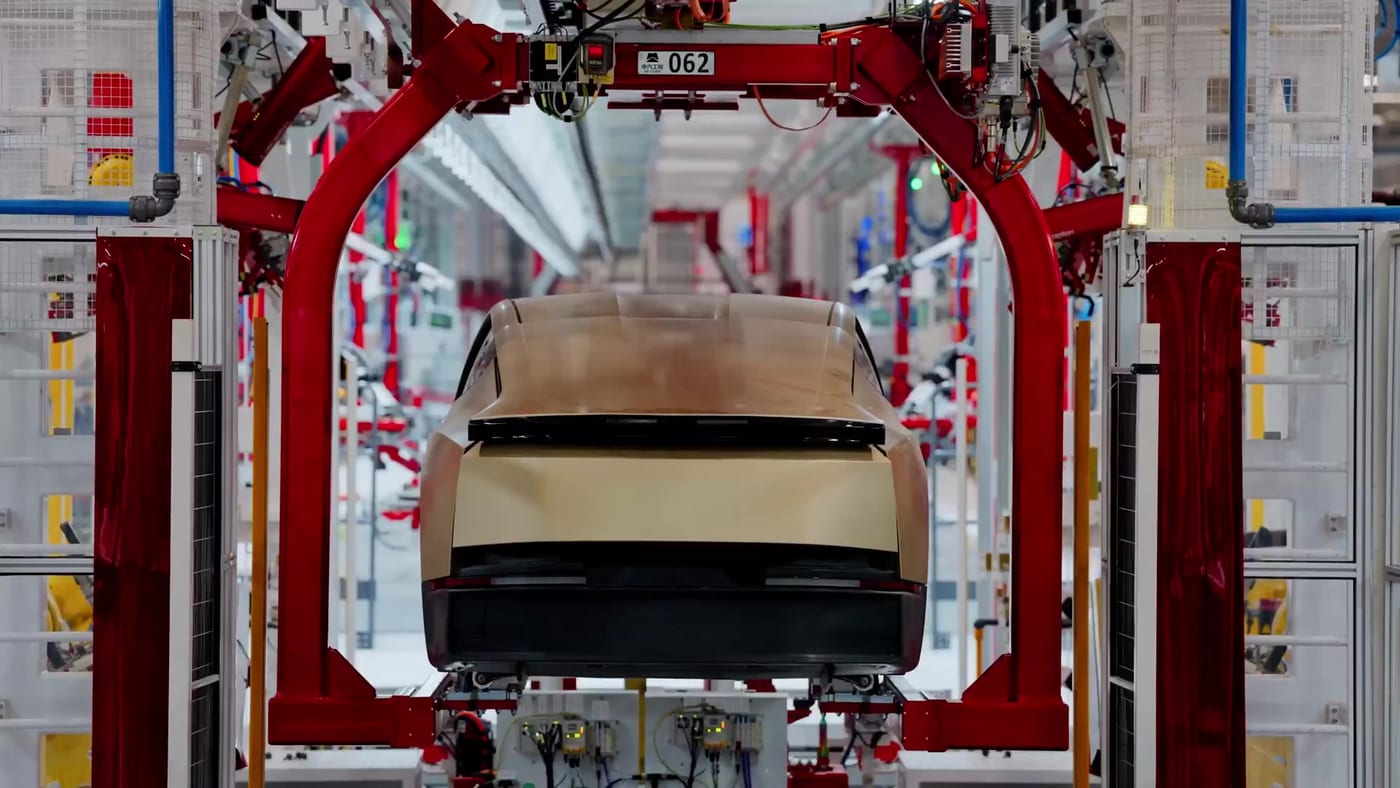
Tesla built the first production Cybercab at Gigafactory Texas in February 2026, and formal production began in April. On 3 Sep 2026, Tesla held a launch event at ACL Live in Austin, and Cybercabs joined the paid Robotaxi fleet the same day.
Carmakers in the US self-certify that their vehicles meet federal safety standards, and a car with no steering wheel or pedals has drawn NHTSA questions. In its third-quarter update, Tesla said cumulative unsupervised Robotaxi miles grew eightfold from the previous quarter.
Part seventeen: FSD today
The software in customers' cars has kept improving. FSD (Supervised) still needs an attentive driver. The miles have grown fast, from three billion in January 2025 to about 15 billion by the end of September 2026, read from the chart in Tesla's Q3 2026 update.
The way Tesla sells it has changed too. Autopilot came standard on every Tesla built from April 2019 to January 2026. As of September 2026 it is no longer offered, and buyers who want driver assistance subscribe to FSD (Supervised), a Level 2 system in SAE's terms that adds navigation on top of steering and cruise control.
Tesla reported 1.74 million active FSD subscriptions as of the end of September 2026, up 67% on a year earlier. That figure counts upfront buyers and monthly subscribers and leaves out free trials.
Owners of older cars have had a rougher deal. From October 2016 Tesla fitted new cars with its "HW2" hardware and said it provided what was needed for full self-driving at SAE level 5, the top level. In April 2026 Musk admitted that cars with the older Hardware 3 computer could not run unsupervised self-driving. On 29 Jun 2026, Tesla started pushing a cut-down "v14 Lite" to some of those cars.
Europe has moved more slowly. On 10 Apr 2026, the Dutch vehicle authority RDW approved FSD (Supervised) after more than 18 months of testing on its track and on public roads. It stressed that the system is driver assistance, not self-driving, and that the driver stays responsible. The approval is provisional, granted under an EU exemption rule for new technology (Article 39 of Regulation 2018/858), and valid only in the Netherlands. Tesla began rolling it out to Dutch owners the same weekend.
Other countries can recognise the Dutch approval for their own roads. Lithuania did so on May 20, Estonia on May 29, Denmark on June 9 and Belgium on June 10. Slovenia, Czechia and Croatia followed in September, Slovakia on October 16 and Latvia on October 26, ten EU countries in all. Germany, France, Spain, Italy and Sweden have not. Sweden's road authority has recommended rejecting it while it can deliberately exceed speed limits. On October 9, after Germany's transport minister called the name misleading, Tesla renamed the system "Tesla Assisted Driving" in Europe. Approval for the whole EU needs 15 of 27 member states, representing 65% of the EU population, in a committee vote. A December 2026 vote has been reported but not confirmed.
Part eighteen: the recovery
Sales and stock
Sales came back, partly. Tesla delivered 486,532 cars in the third quarter of 2026. That beat analysts' expectations of about 461,000 and was up on the second quarter, though still 2% below the same quarter of 2025. Bloomberg reported that European demand was recovering.
The stock recovered faster than sales. After its April 2025 low, Tesla closed at a record $489.88 on 16 Dec 2025. Its market value stayed above $1 trillion from May 2025 to July 2026. In November 2025 shareholders approved a new pay package for Musk worth up to $1 trillion over ten years, if he hits a long list of targets that include market value, robotaxis and robots.
The end of the Model S and X
Tesla also let go of its past. On 28 Jan 2026, on the company's fourth-quarter earnings call, Musk said Tesla would stop making the Model S and Model X, the cars that kept the company alive a decade earlier, to focus on building Optimus robots. The Model S had been built from 2012 and the Model X from 2015. Both were still on the original platform.
Energy
The "zero emission electric power generation" part of the plan, which barely registered for years, has turned into one of Tesla's steadiest businesses. Megapacks now go to utilities and data centers. SpaceX alone bought $480 million of Megapacks in the first nine months of 2026, according to its own quarterly filing.
The factory side grew to match. In 2021 Tesla bought a former JCPenney distribution center in Lathrop, California, and turned it into a Megapack plant it calls the Megafactory, opened in 2022, with a target of 40 GWh a year. Newer Megapacks use lithium iron phosphate cells. One project, at Kapolei in Hawaii, came online in 2024 at 585 MWh.
Part nineteen: Optimus
Tesla announced Optimus at its AI Day event on 19 Aug 2021. It was planned to be 5 ft 8 in tall and weigh 125 lb, run on the same AI Tesla was building for its cars, and do work that is "boring, repetitive, and dangerous". At the second AI Day in September 2022, one prototype walked onto the stage and waved. A sleeker version, which couldn't yet stand on its own, was wheeled out on a stand. A second generation followed in December 2023. Critics have repeatedly pointed out that robots in Tesla's later demos were partly controlled by people through teleoperation.
In April 2026 Tesla said Optimus production lines were being installed at Fremont, and Musk had tied the end of the Model S and X to that plan. As of its Q3 2026 update, Tesla lists Optimus in "early ramp" in California, with a Texas Optimus plant under construction. Optimus also appeared at the We, Robot event in October 2024, alongside a single concept Robovan, a larger self-driving people carrier for which Tesla gave no timeline. A third-generation design had not been shown publicly as of September 2026. Musk has said he expects Optimus to be the largest part of Tesla's value. For now it is the part with the least public evidence.
Part twenty: Tesla and SpaceX
The line between Musk's companies is getting thinner. In March 2026 Tesla invested about $2 billion in SpaceX, a stake of less than 1%. On 21 Mar 2026, SpaceX announced Terafab, a joint chip-making project with Tesla and xAI.
In October 2026 the boards of Tesla and SpaceX each set up special committees of independent directors to look at a possible combination of the two companies. No deal, terms or vote have been announced.
Part twenty-one: the Roadster comes back
The story ends where it started, with a sports car.
In November 2017 Tesla drove a new Roadster out of the back of a Semi trailer and promised 0 to 60 mph in 1.9 seconds, with production in 2020. In February 2018 Musk's own first-generation Roadster, a 2010 car, flew as the dummy payload on the first Falcon Heavy test flight. A mannequin in a SpaceX spacesuit, "Starman", sat in the driver's seat. The car is now in orbit around the Sun. In June 2018 Musk tweeted that a "SpaceX option package" for the new car would include about ten small rocket thrusters, and said maybe it could even fly. A day later he explained that the gas would be ultra-high-pressure air stored in a SpaceX COPV, the kind of carbon-wrapped pressure tank SpaceX uses on its rockets. The car itself never came.
On 15 Oct 2026, Tesla finally unveiled a redesigned Roadster at SpaceX's rocket test site in McGregor, Texas. With a mannequin in a SpaceX suit in the driver's seat and nobody driving, it used fans and cold-gas thrusters built with SpaceX to drive up an inverted ramp and flip back down. Later it jumped over a row of Teslas. Musk called it "the culmination of incredible work by Tesla and SpaceX engineers working closely together."
Tesla engineering VP Lars Moravy said the thrusters draw on about 600 liters of rechargeable compressed air. Tesla claims 0 to 60 mph in 0.81 seconds and more than 300 miles of range, less than half the 620 miles promised in 2017. Musk's target for production is 2028. Prices haven't been announced, but reservations cost $50,000 for the Performance version and $250,000 for Thrust, and the flying Rocket version is invite-only. The FAA told reporters the car doesn't meet its definition of an aircraft.
Where the plan ended up
In 2006 the plan was a sports car, then a cheaper car, then a cheaper one still, with clean power on the side. Tesla got there, about a decade late on most of it and close to bankruptcy more than once. Count the products and the pace is clearer. Tesla started production of the Roadster in 2008, the Model S in 2012, the Model X in 2015, the Model 3 in 2017, the Model Y in 2020, the Semi in 2022, the Cybertruck in 2023 and the Cybercab in 2026. It stopped making three of those: the original Roadster in 2012, and the Model S and Model X in 2026. The Model 3 and Model Y, the two cheapest cars Tesla has made, are still in production. In the third quarter of 2026 they made up 478,237 of the 486,532 cars Tesla delivered.
The next plan, cars without drivers and robots on a production line, is still being tested on public roads and factory floors.
The people who bought Tesla shares at the 2010 IPO paid $17 each. After two splits, that is about $1.13 a share. On 27 Oct 2026, Tesla closed at $407.46, roughly 360 times the money.
— Alex R
Credits
Film: "Tesla: The Plan" (Parts 1–3), Supercharged Daily. Narration: AI voice, Kokoro-82M ("am_michael" stock voice, Apache-2.0). Music: "Resonance" by Scott Buckley, CC BY 4.0 (scottbuckley.com.au).
Footage, Part 1: Tesla (Model S first deliveries 2012 via @wholemars; Supercharger unveil 2012 via @DillonLoomis; Model 3 unveil 2016 via @tslaming; Fremont factory and production clips, @Tesla on X). Tesla Motors Roadster unveil, 2006 (via @noorg420). Roadster in the snow, 2009 (via @SawyerMerritt). Bellevue reservation line, 2016: @BharathNA, shared by @Tesla. CBS This Morning / CBS News, Gayle King at Fremont, April 2018 (@CBSMornings, @CBSNews; couch clip via @Dogetothemoon). Archive b-roll: @PrimeUniverseHQ.
Footage, Part 2: Tesla (Cybertruck unveil 2019; Battery Day 2020 via Reuters; Autonomy Day 2019 via CNBC / @EvanKirstel; We, Robot 2024). Xinhua (via @Tslachan); @Tslachan; @SPCX100T; Elon Musk livestream on X (via @OWENSPARKS_, @farzyness / @DavidCarbutt_); @DOGEQEEN; Reuters; Sky News; ABC News (footage Hal Sparks via Storyful); WION (@WIONews); La Dépêche du Midi (@ladepechedumidi); KMBC 9 News (via @publicfreakoutx); KOIN 6 News (via @MrAndyNgo); FOX 12 Oregon (via @KarluskaP); WBZ / CBS News Boston (via @NewsFlashMeta); U.S. Department of Justice (via @dotconnectinga).
Footage, Part 3: @Tesla, @robotaxi, @teslaeurope, @Tesla_Optimus, @BloombergTV, @artsimage, @davelee, @MissJilianne.
Photos (Wikimedia Commons): Steve Jurvetson (CC BY 2.0); Nicki Dugan (CC BY-SA 2.0); OnInnovation (CC BY-SA 2.0); Rutger van der Maar (CC BY 2.0); Mark Hillary (CC BY 2.0); Ellen Levy Finch (CC BY-SA 3.0); Alexander Migl (CC BY-SA 4.0); Paul Sladen (CC0); Votpuske (CC BY 4.0); The White House (public domain); Rhododendrites (CC BY-SA 4.0).
Text and data: Posts by @elonmusk; "The Secret Tesla Motors Master Plan", Tesla Motors blog, August 2006; Tesla investor relations and Q3 2026 update; Supercharger data from supercharge.info; Yahoo Finance (TSLA closes, split-adjusted); ACEA; JATO Dynamics; BYD; Texas DMV; NHTSA; Reuters; Bloomberg; CNBC; TechCrunch; Fortune; Motor Trend; U.S. Department of Energy.
Sources checked for this piece include Tesla's Q3 2026 update (8-K, 21 Oct 2026) and delivery releases, SEC filings, Yahoo Finance split-adjusted TSLA closes, the Texas DMV automated-vehicle register, BYD's 2025 sales report (via CnEVPost), and the outlets listed in the credits. Figures are as of 29 Oct 2026 unless dated. This history is a fan account; corrections are welcome via the contact page.