Tesla · Regulation · 10 Nov 2026
Tesla comments on NHTSA’s plan to overhaul U.S. headlight rules, asking that cameras, software and more automaker seats be covered (as of 10 Nov 2026)
In a public comment dated 9 Nov 2026, Tesla told the National Highway Traffic Safety Administration that the federal lighting standard “was written for an era” of replaceable bulbs and two static beams. It wants the coming overhaul of FMVSS No. 108 to cover camera-guided matrix LED headlights and lighting that can be refined over the air, and it wants more individual automaker seats on the committee NHTSA plans to form. This is a comment on a notice of intent, not a petition for a new rule. No rule has changed, and Tesla owners will see nothing different on the road.
On this page
The editor holds Tesla and SpaceX shares. Supercharged Daily is independent and not affiliated with either company. Nothing here is financial advice.

What Tesla filed
The three-page letter is addressed to NHTSA Administrator Jonathan Morrison and signed by Suraj Nagaraj, Tesla’s senior director of safety and homologation engineering. It is dated 9 Nov 2026, the last day for comments on the notice, and is logged on regulations.gov as a public comment (received 9 Nov, posted 10 Nov). Sawyer Merritt flagged it on X at 9:43 a.m. ET (6:43 a.m. PT) on 10 Nov 2026.
Tesla has submitted a new letter to NHTSA, urging the federal government to modernize U.S. vehicle lighting regulations.
— Sawyer Merritt (@SawyerMerritt) November 10, 2026
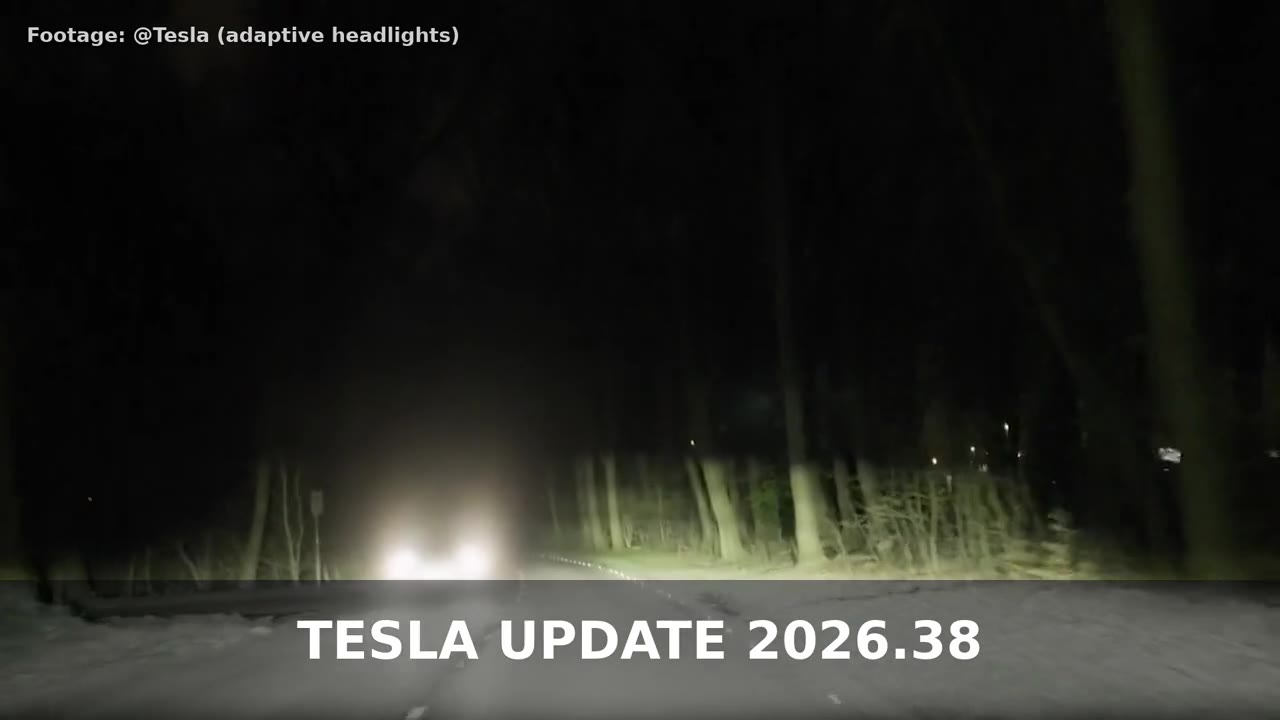
Tesla argues that existing regulations were designed for traditional headlights, not modern matrix LED systems that use vehicle cameras to detect other vehicles, pedestrians, and cyclists and dynamically adjust light beams to improve visibility and reduce glare.
Tesla also wants regulations to account for lighting improvements delivered through over-the-air software updates and is pushing for automakers to have greater representation in shaping the new rules.
Tesla: "We do not treat lighting as an isolated supplier module whose only “sensor” is a dusk photocell. Lighting behavior is informed by the same surround-camera suite that continuously observes the driving scene: oncoming headlamps, preceding taillamps, pedestrians, cyclists, lane geometry, and ambient illumination. Semiautomatic beam switching and adaptive driving beam functions are therefore scene understanding problems, not binary light-threshold problems.
Tesla has concerns about NHTSA’s proposed composition of the advisory committee tasked with reaching consensus recommendations. Specifically, Tesla urges the agency to increase the number of individual vehicle manufacturer committee members from the current proposal of just two representatives. The current proposal does not accurately reflect the interests of individual motor vehicle manufacturers, particularly when those interests will not be represented by a trade or industry association member of the committee."
Post: Sawyer Merritt (@SawyerMerritt), 9:43 a.m. ET on 10 Nov 2026 (6:43 a.m. PT). Embedded from X via x-embed.js. The blockquote is the full post text. Sawyer’s framing (“urging the federal government to modernize”) is his; NHTSA had already announced the overhaul, and Tesla’s letter is a comment on that notice.
Tesla’s case is that its headlights are a software system. Its matrix LED units have “individually addressable segments” controlled in real time by vehicle software, and “beam shape, intensity distribution, and switching are not locked at the factory into a single pair of photometric patterns.” The company says the lighting can be “refined over the air, within the certified performance envelope.” It also says the lights take their cues from the same cameras that watch for “oncoming headlamps, preceding taillamps, pedestrians, cyclists, lane geometry, and ambient illumination.” So for Tesla, “semiautomatic beam switching and adaptive driving beam functions are therefore scene-understanding problems, not binary light-threshold problems.”
Glare, upper- and lower-beam photometry, aim and mounting height, and adaptive-beam performance, the letter says, “cannot be resolved by lamp-level laboratory points alone.”
What NHTSA is actually doing
The letter answers an 8 Oct 2026 Federal Register notice (docket NHTSA-2026-1981) in which NHTSA said it intends to form a negotiated rulemaking committee to modernize Federal Motor Vehicle Safety Standard No. 108, the rule covering lamps, reflective devices and associated equipment. In a negotiated rulemaking, the agency gathers the affected parties on a committee and tries to reach consensus first. If they agree, the Department issues a proposed rule consistent with that consensus for public comment; the 8 Oct notice also says the Secretary may approve the committee’s recommendations “either as submitted or in modified form.”
The agency asked for comments on two things: the committee’s scope and the balance of its membership. Comments were due 9 Nov 2026, and membership applications were due by 5 p.m. ET (2 p.m. PT) the same day. The regulations.gov record for the notice shows the comment window closed at 11:59 p.m. ET on 9 Nov 2026 (8:59 p.m. PT), with late comments not accepted.
The scope NHTSA listed is wide. It includes glare from headlighting systems, replaceable light sources, dusk sensors, semiautomatic beam switching, low- and high-beam photometry, how headlamps perform once mounted on the car (aim and mounting height) and “harmonization to international standards,” among other topics. The committee would meet about four times a year in public, mostly online, and its charter runs two years unless renewed. NHTSA says it intends to publish a proposed rule “promptly” after the committee hands in its recommendations and the Secretary approves them. It gave no date for a final rule.
Drivers have flooded the docket. The regulations.gov comments API listed 5,722 posted comments as of about 3:35 p.m. ET on 10 Nov 2026; that figure may still rise as NHTSA posts more of what it received. Of nine individual comments opened for this piece, eight were about glare from bright headlights, including one that just said “Tesla headlights are blinding.” That is a small sample, not a count of the whole docket. General Motors filed a committee nomination, and the Alliance for Automotive Innovation filed comments on 9 Nov 2026. The Alliance’s attached PDF could not be retrieved for this piece, so its arguments are not described here.
The 2022 rule that let matrix beams in
Adaptive driving beam (ADB) headlights became legal in the U.S. through a final rule published 22 Feb 2022 (PDF), which took effect that day. Before it, NHTSA wrote, ADB systems were “available in foreign markets but are not currently offered on vehicles in the United States.” Europe had allowed them since amendments to UN ECE Regulation 48 in 2006, according to the same rule.
The two systems prove compliance differently. Europe uses type approval, in which a technical-service engineer drives the car on public roads and subjectively judges whether the beam causes discomfort or glare. NHTSA rejected that model because the ECE road test “does not provide sufficiently objective performance criteria.” The U.S. rule is built around measurement. The car drives a test track past fixtures fitted with real headlamps and taillamps, and illuminance at the fixtures is capped by distance under Table XXI. Toward oncoming traffic those caps tighten with range: 3.1 lux from 15.0 to just under 30 meters, 1.8 lux from 30 to 60 meters, 0.6 lux from 60 to 120 meters, and 0.3 lux from 120 to 220 meters. Below 20 mph (32 km/h) the system must provide only lower beams, unless the driver overrides. Every area of reduced intensity still has to meet the Table XIX lower-beam laboratory photometry requirements, and every area of unreduced intensity has to meet the Table XVIII upper-beam requirements.
Industry pushed back on that design while the rule was being written. NHTSA’s summary says many industry commenters wanted closer alignment with the SAE J3069 practice or the ECE rules, warning of “costs from disharmonization due to the resulting need for market-specific hardware, components, and/or software.” Several said those costs would “hinder ADB adoption.”
Tesla’s own U.S. rollout came years later. Its 2025 Spring update, announced 11 Apr 2025 at 8:10 p.m. ET (5:10 p.m. PT), listed “Adaptive Headlights (US + Canada)” for cars with the right hardware, more than three years after the U.S. rule took effect. Writing about that update, The Verge reported that Tesla had started fitting the hardware in 2022 and that Ford’s F-150 Lightning had the hardware too but was not switching on all adaptive features by default.
Tesla’s asks against today’s rule
| Topic | FMVSS 108 today (with the 2022 ADB rule) | What Tesla asks for |
|---|---|---|
| Beam patterns | A lower beam and an upper beam, each with laboratory photometry tables. In automatic mode an ADB system “must only switch between lower, upper, and adaptive driving beams.” | Rules that fit beams shaped live by software, with no single pair of factory patterns. |
| How compliance is shown | Laboratory tests on the lamp plus a track test against fixed fixtures with Table XXI lux caps. | Treat glare, photometry, aim and mounting height as system-level outcomes, not just laboratory points. |
| What the system detects | Track fixtures stand in for oncoming headlamps and preceding taillamps. | Account for “camera-based, multi-object detection,” including pedestrians, cyclists and lane geometry. |
| Software changes after sale | The 2022 ADB rule does not address over-the-air updates. | Allow lighting to be refined over the air within the certified envelope. |
| Committee seats | NHTSA proposed up to 18 members: 4 lighting makers or retailers, 2 vehicle makers, 4 manufacturing associations, 2 safety groups, 3 research or testing bodies, 3 engineering or standards bodies, plus a NHTSA representative. | More individual automaker seats, at least in proportion to lighting suppliers and manufacturing associations, and a bigger committee overall. |
Sources: 87 FR 9916 (including S9.4.1.6.4 and Table XXI); 91 FR 64462; Tesla comment.
The seat fight
Half of the letter is about who sits on the committee. Tesla says the proposed mix “skews heavily in favor of vehicle lighting manufacturers and lighting retailers” and that two automaker seats cannot cover individual carmakers whose views a trade group will not carry. It points out that the Negotiated Rulemaking Act allows up to 25 members, and more if needed “to achieve balanced membership.” Carmakers certify the finished vehicle, Tesla argues, so they should not be “one of the groups least represented.” The letter also notes that NHTSA’s last negotiated rulemaking on FMVSS 108, in 1995, covered a single issue, lower-beam patterns, while this one spans the whole list above.
NHTSA itself invited this kind of argument. The notice asks anyone who feels the categories “do not fully represent their interests” to explain why in a comment.
What changes for owners
Nothing yet. Adaptive Headlights on Tesla’s U.S. cars, switched on with the 2025 update, keep working as they do today. Next, NHTSA weighs the comments and sets up the committee, which then has up to two years to agree on recommendations. A proposed rule would follow, with its own comment period, before anything is final. Tesla’s ideas on software-shaped beams would have to survive a room where, on NHTSA’s current plan, four seats go to lighting makers or retailers and two go to carmakers. They would also have to answer the thousands of drivers who told the agency their main problem is glare.
If you are wondering about the low beams that started re-aiming themselves this fall, that is a separate feature. I covered it in Tesla’s Dynamic Headlight Leveling story.
— Alex R
Sources: Tesla, Inc. comment to NHTSA, Docket NHTSA-2026-1981 (dated 9 Nov 2026; posted 10 Nov 2026); NHTSA notice of intent, 91 FR 64462 (8 Oct 2026); Docket NHTSA-2026-1981 on regulations.gov; regulations.gov API for document NHTSA-2026-1981-0001 and comment NHTSA-2026-1981-4728 (checked 10 Nov 2026); NHTSA ADB final rule, 87 FR 9916 (22 Feb 2022); Tesla on X, Spring Release (11 Apr 2025, ET); The Verge (17 Apr 2025); Sawyer Merritt on X (10 Nov 2026). Related: Headlights that aim themselves. Hero photo: Aos.1905 / Wikimedia Commons, CC BY 4.0. Never Electrek.