Tesla · Energy · 18 Nov 2026
Tesla's Powercore puts a transformer, breaker and inverter in one box. First units run in 2027
Tesla Energy unveiled Powercore on Tuesday, a solid-state unit rated at 7.4 MW that converts power between the medium-voltage grid and the DC side of batteries, solar farms and AI data centers in a single step. Tesla says it will build it in the U.S. and have the first units operating in 2027. It hasn't given a price, a factory or a first customer.
On this page
The editor holds Tesla and SpaceX shares. Supercharged Daily is independent and not affiliated with either company. Nothing here is financial advice.

What Tesla announced
The Tesla Megapack account posted the launch at 11 a.m. ET (8 a.m. PT) on Tuesday, 17 Nov: "Solid state medium voltage transformer, inverter and breaker." About an hour later it followed with a long X Article, "The Future Runs on Powercore," which has the specs and Tesla's case for the product. Tesla is showing it this week at the RE+ 2026 trade show in Las Vegas, pv magazine USA reports.
Introducing Powercore. Solid state medium voltage transformer, inverter and breaker – reliable, safe and secure. 7.4 MW/9 MVA continuously at 34.5 kVac w/ grid-forming support for 10MVA of peak power. Made in America. Operating 2027
— Tesla Megapack (@Tesla_Megapack) November 17, 2026
Tesla's specs: up to 9 MVA (7.4 MW) continuously at 34.5 kV AC, 10 MVA peak for grid-forming, a nominal AC range of 10 to 34.5 kV, DC from 800 to 2,000 V, peak efficiency of 98.86%, a warranty of up to 25 years and an operating range of −40°C to 55°C. It has no oil inside, and Tesla says its built-in solid-state breaker clears faults "up to 1,000x faster than a conventional breaker."
What it replaces
Batteries, solar panels and data center racks all run on DC, and the grid runs on AC. Today each site bridges that with separate inverters and a made-to-order transformer. Tesla's pitch is that one Powercore box does the whole conversion. Here is how its article describes the change for each of the three markets.
| Use | How it's done today (per Tesla) | With Powercore (per Tesla) |
|---|---|---|
| Battery storage (Megapack) | Inverters in each Megapack turn battery DC into 480 V AC, then a transformer steps it up to grid voltage. Two conversions. | Battery DC straight to medium-voltage AC in one stage. Tesla says the old setup had "2x the losses." |
| AI data centers | Most equipment takes 415 to 480 V AC from a transformer, and power is converted again for cooling, networking and chips. | Medium-voltage feeder straight to 800 V DC for the racks, with up to 99.7% availability per unit. |
| Utility solar | Separate inverters and transformers. Tesla says inverter warranties typically run 5 to 10 years. | Works as a central inverter for today's 1,500 V and newer 2,000 V arrays, with up to 25 years of warranty. |
Source: Tesla, "The Future Runs on Powercore", 17 Nov 2026. These are Tesla's claims; no independent test data has been published.
Buyers care because of supply. Transformer lead times have reached as long as four years, pv magazine USA notes. AJ Booth, Tesla's head of energy and charging, told the outlet that Tesla has "done 3 terawatts of power converters" and wants to give customers "a bankable and reliable pathway" to what he called "fundamentally a new technology to the industry."
The data center math
Tesla's article ends with its biggest claim: in many parts of the world, "a 100 MW data center can be effectively powered with 500 MW of solar and 1.7 GWh of batteries," running on 800 V DC end to end. Its launch video calls this "fully off-grid data centers."
I ran Tesla's own numbers. The solar array would be five times the data center's load. The batteries could carry the full 100 MW for 17 hours with no sun. At 7.4 MW per unit, the load alone needs at least 14 Powercores before any spares for redundancy. Tesla gives no cost for a site like that, and it doesn't name one that exists.
Tesla is also working with Nvidia on 800 V DC power for next-generation data centers. Megapack already qualifies under Nvidia's DSX Ready program, and Tesla is working to get Powercore certified too, pv magazine USA reports. That's the same Nvidia whose results on Tuesday named SpaceXSI as a Vera Rubin customer.
Announced vs done
- Done: Tesla says it has more than 100 GWh of storage operating across 2,000 projects in 68 countries, 10 GWh of Megapack at data centers, and Megapack 2 XL running at 99.73% average annual availability across more than 50 GWh as of Q3 2026.
- Announced, not delivered: Powercore itself. "First units operating in 2027," made in the U.S., with no plant named.
- Pledge: Tesla repeats that it has "committed to manufacturing 100 GW of solar in the U.S. annually." That's a target, not current output.
- Missing: price, launch customer, factory location and any third-party efficiency test.
My read
Tesla already sells the batteries at these sites. If Powercore works, it also sells the box that connects them to the grid, plus the one that feeds the racks, and that's a bigger share of each project. Tesla's energy business has usually earned better margins than its cars, pv magazine USA notes, and this is the most interesting product it has shown there in a while. A year or more until first units is a long time in a market this short of transformers, though. Is Powercore a real threat to the transformer makers, or a 2027 slide until someone buys one? Tell me below.
— Alex R
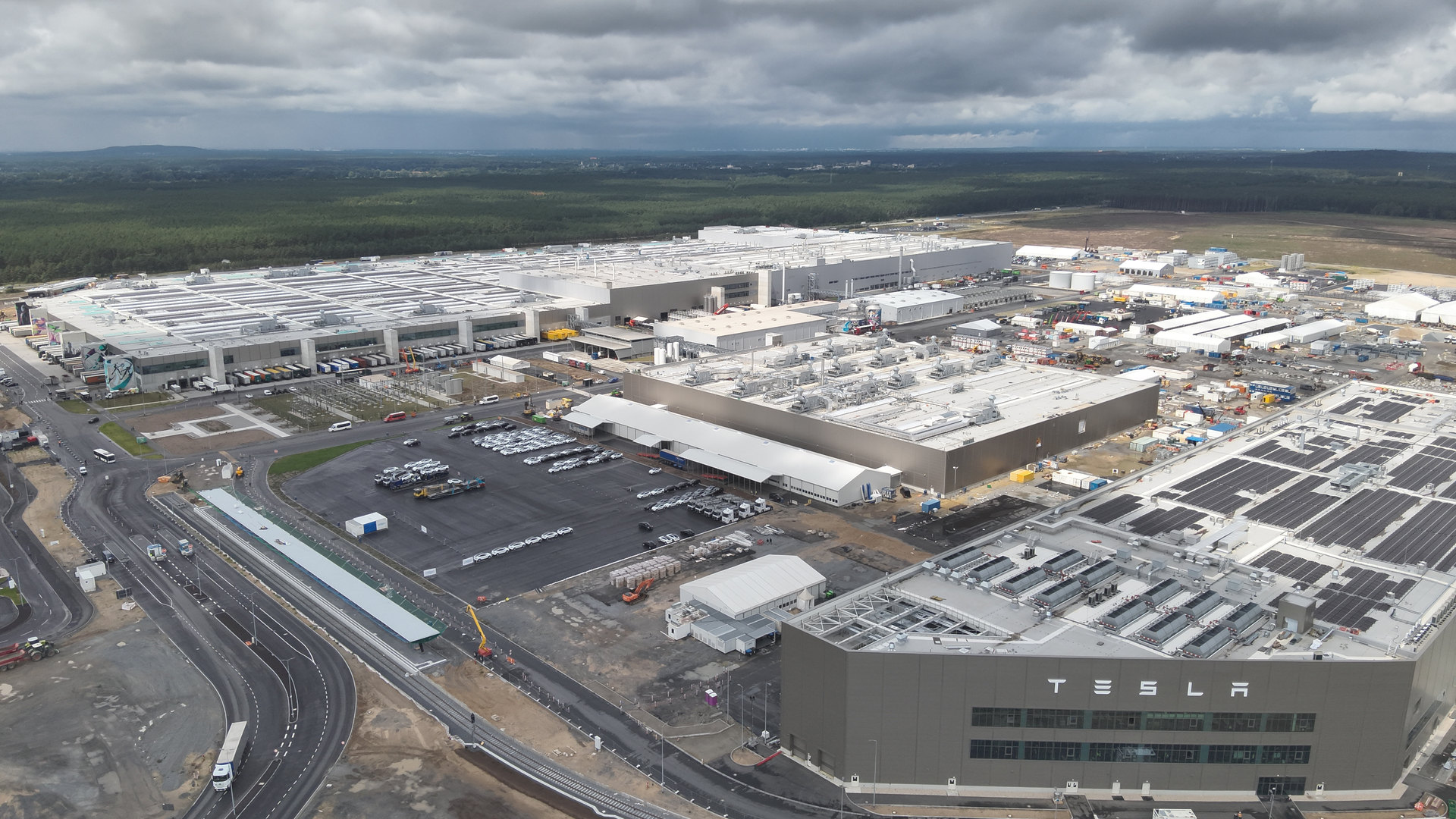
Sources: Tesla Megapack on X, launch post and "The Future Runs on Powercore", 17 Nov 2026; pv magazine USA (Ben Zientara), 17 Nov 2026. Unit count, solar ratio and battery hours are my arithmetic on Tesla's figures. Photo: Smnt, CC BY-SA 4.0, via Wikimedia Commons. I could not find a photographic Megapack image on Commons (the files titled Megapack there are 3D models or datasheet graphics).