SpaceX · Starmind · 15 Oct 2026
Elon Musk: SpaceX and Nvidia’s Star Mind computer hits volume production next year
Musk says the orbital AI computer SpaceX is building with Nvidia is “far better than almost anyone expects” and will be made in volume in 2027, after Jensen Huang said the two companies are designing a new kind of server for data centers in space.
SpaceX is partnering with @Nvidia to design the Starmind AI1 satellite compute payload.
— SpaceX (@SpaceX) View the post on X
SpaceX’s plan to put AI data centers in orbit now has a production year attached. In a post on Thursday at 1:48pm ET (10:48am PT), Elon Musk wrote that the Star Mind computer being co-engineered by SpaceX and Nvidia “will reach volume production next year.” He called it “far better than almost anyone expects” and described working with Nvidia’s engineers as “pure joy.”
Musk was quoting a clip of Nvidia CEO Jensen Huang. In it, Huang says he enjoys working with Musk and that the two companies’ engineering teams are designing a new type of server meant to run data centers in space. Musk opened his reply simply: “Old friends are the best friends. Jensen rocks.”
What Star Mind actually is
Starmind is SpaceX’s name for its space-based AI compute program, and AI1 is the satellite that carries it. According to SpaceX’s Starmind page, each AI1 has a compute payload rated at up to 250 kW peak and 175 kW on average. The satellite stands 30 meters (98 ft) tall when deployed, with a 75-meter (246 ft) wingspan, and SpaceX lists its efficiency at 75 kW per ton.
The pitch is simple. Power and cooling are the two things that are getting hard to find for data centers on the ground. In a sun-synchronous orbit, SpaceX says, AI1 gets near-constant sunlight with no weather in the way. Heat can radiate straight into space, which the company says cuts cooling power overhead by an order of magnitude compared with chillers, fans and cooling towers on Earth. The results don’t come down by radio dish. Laser links pass them between satellites and back to Earth through the Starlink network.
Nvidia’s role was made public in August. In the @SpaceX post above, the company said it is partnering with Nvidia on the AI1 compute payload, and that each satellite will carry Nvidia Rubin GPUs and Vera CPUs. SpaceX also says its design is chip-vendor agnostic, so compute modules from other suppliers can be fitted.
Where they’ll be built
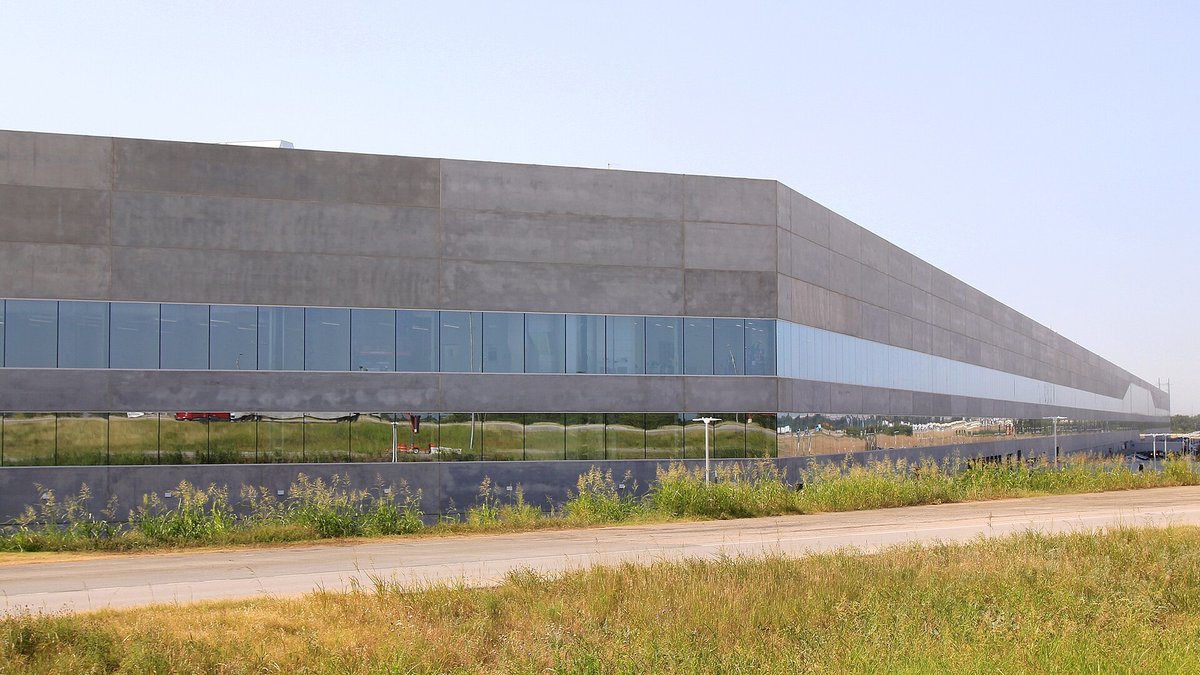
SpaceX says it is building a Gigasat Factory in Bastrop, Texas, to make AI satellites at large scale. The company’s own wording is that the plant should enable thousands of AI satellites “starting as soon as late 2027.” It names Starship as the vehicle needed to get these large, heavy satellites to orbit, and says it plans to make AI chips at scale in Terafab, a fab it is building jointly with Tesla.
Back on 7 October, SpaceX showed what a constellation of a million AI satellites would look like, roughly 90 times the size of today’s Starlink. I covered that on the SpaceX page. Thursday’s update is the first time Musk has put a year on volume production of the computer itself.
What “volume production next year” does and doesn’t mean
Musk’s post is about the Star Mind computer, the compute hardware SpaceX and Nvidia are designing together. The Gigasat Factory timeline on SpaceX’s site is about the satellites, and it still says late 2027 at the earliest. Those two dates fit together: compute modules would need to be coming off a line before satellites can be built around them at scale. Neither SpaceX nor Nvidia has given a unit count, a price or a first launch date for AI1.
Speculation
This part is my read, not anything SpaceX or Nvidia has announced. If computers are being built in volume during 2027 and the Bastrop factory starts as planned late that year, the first operational AI1 launches could plausibly land in 2028. The bigger swing factor is Starship. SpaceX itself calls fully reusable Starship critical for lifting these satellites, so the pace of Starship flights is likely to set the pace of Starmind more than chip supply does. Musk’s timelines also have a history of slipping, so 2027 is a target, not a guarantee.
Sources: Elon Musk on X, 15 Oct 2026; Jensen Huang interview clip as posted on X, 15 Oct 2026; SpaceX Starmind page (spacex.com/spacexai/starmind); @SpaceX on X, 4 Aug 2026. Video by SpaceX (@SpaceX).
Data centers that run on sunlight and cool themselves in vacuum. I want to see the first one leave the pad.
— @AlJR86