SpaceX · Starship · 16 Nov 2026
Fifteen flights to a caught ship: every Starship flight, explosions included
Starship's first flight in April 2023 ended with SpaceX commanding its flight termination system on a tumbling rocket. On Saturday, Nov 14, 2026, the tower at Starbase caught a Starship upper stage for the first time. This is the whole run, flight by flight, including the vehicles SpaceX lost on the way.
On this page
The editor holds Tesla and SpaceX shares. Supercharged Daily is independent and not affiliated with either company. Nothing here is financial advice.
Flight 1: the rocket that tumbled
On April 20, 2023, Starship and Super Heavy flew together for the first time, lifting off from the orbital launch pad at Starbase at 8:33 a.m. CT. The stack climbed to about 39 km over the Gulf of Mexico. After several engines went out, the vehicle lost altitude and began to tumble. SpaceX then commanded the flight termination system on both the booster and the ship.
SpaceX's recap that day was short on spin: "With a test like this, success comes from what we learn, and we learned a tremendous amount about the vehicle and ground systems today."
Flight 2: hot staging works
Seven months later, on Nov 18, 2023, all 33 booster engines ran the full ascent burn for the first time. The ship then lit its own engines while still attached, venting the exhaust through the interstage. SpaceX said it was the first time hot staging had been done successfully with a vehicle that size. The ship reached space at about 150 km.
Neither stage came home. The booster broke up during its boostback burn at about 90 km, and the ship was lost near the end of its burn when its destruct system triggered.
Flight 3: back in from space
On March 14, 2024, the ship completed its full ascent burn and tested its payload door and a propellant transfer in space. It then came back into the atmosphere from space for the first time, with the entry streamed live over Starlink. It was lost about 49 minutes into the flight. The booster broke up about 462 m above the Gulf during its first landing burn.
Flight 4: both stages down
On June 6, 2024, both stages made soft splashdowns. The booster set down in the Gulf, and the ship survived reentry and flipped for a landing burn over the Indian Ocean about an hour and six minutes after liftoff. Flight 3 had shown the ship could come back from space. Flight 4 showed it could stay in one piece long enough to land.
Flight 5: the first catch
On Oct 13, 2024, Super Heavy flew back to the launch site and the tower's arms closed around it. SpaceX's post: "On our first try, Mechazilla caught the booster." The ship splashed down on target later that hour.
Flight 6 followed on Nov 19, 2024. Tower health checks called off the catch and the booster splashed down instead, but the ship relit a Raptor engine in space for the first time, which a ship has to do before it can deorbit on purpose.
Flights 7 to 9: the hard year
Flight 7, on Jan 16, 2025, debuted what SpaceX called "a huge block of upgrades to the upper stage." The booster was caught again. The ship was lost about 8.5 minutes in after a fire in its aft section.
Flight 8, on March 6, brought the third booster catch and another lost ship, this time about 9 minutes 30 seconds after liftoff following an energetic event in the aft section.
Flight 9, on May 27, flew the first reused Super Heavy, the booster from Flight 7. SpaceX used it for a landing burn test and it was lost about six minutes in. The ship's payload door failed and the ship was lost about 46 minutes into the flight.
That made three upper stages lost in a row, and SpaceX flew again three months later.
Flights 10 and 11: clean sweeps
On Aug 26, 2025, Flight 10 met every major objective SpaceX set. The ship deployed its first payload, eight Starlink simulators, and both stages ended in splashdowns.
Flight 11, on Oct 13, 2025, did it again. It was the last flight of the second-generation ship and first-generation booster, and the last launch from Pad 1 in its current configuration. The ship flew a banking maneuver that mimicked a return to Starbase.
Flights 12 to 14: V3 and orbit
Flight 12, on May 22, 2026, brought the V3 ship and booster and their Raptor 3 engines, launching from Pad 2 for the first time. The booster made a hard splashdown after a partial boostback. The ship lost a vacuum Raptor, held its trajectory and splashed down on two engines.
Flight 13, on July 24, deployed the first 20 Starlink V3 satellites. The ship came down softly and rested intact, and SpaceX said it got "critical views of an intact heatshield for the first time."
Flight 14, on Sep 28, put Starship into orbit for the first time, carrying 26 Starlink V3 satellites, its first meaningful payload to orbit. The ship made its first deorbit burn and splashed down in the north Pacific.
Flight 15: Mechazilla catches Starship
Flight 15 lifted off from Pad 2 on Friday, Nov 13, at 5:48 p.m. ET (2:48 p.m. PT). After hot staging, the ship reached orbit on a single-Raptor insertion burn and deployed all 26 Starlink V3 satellites.
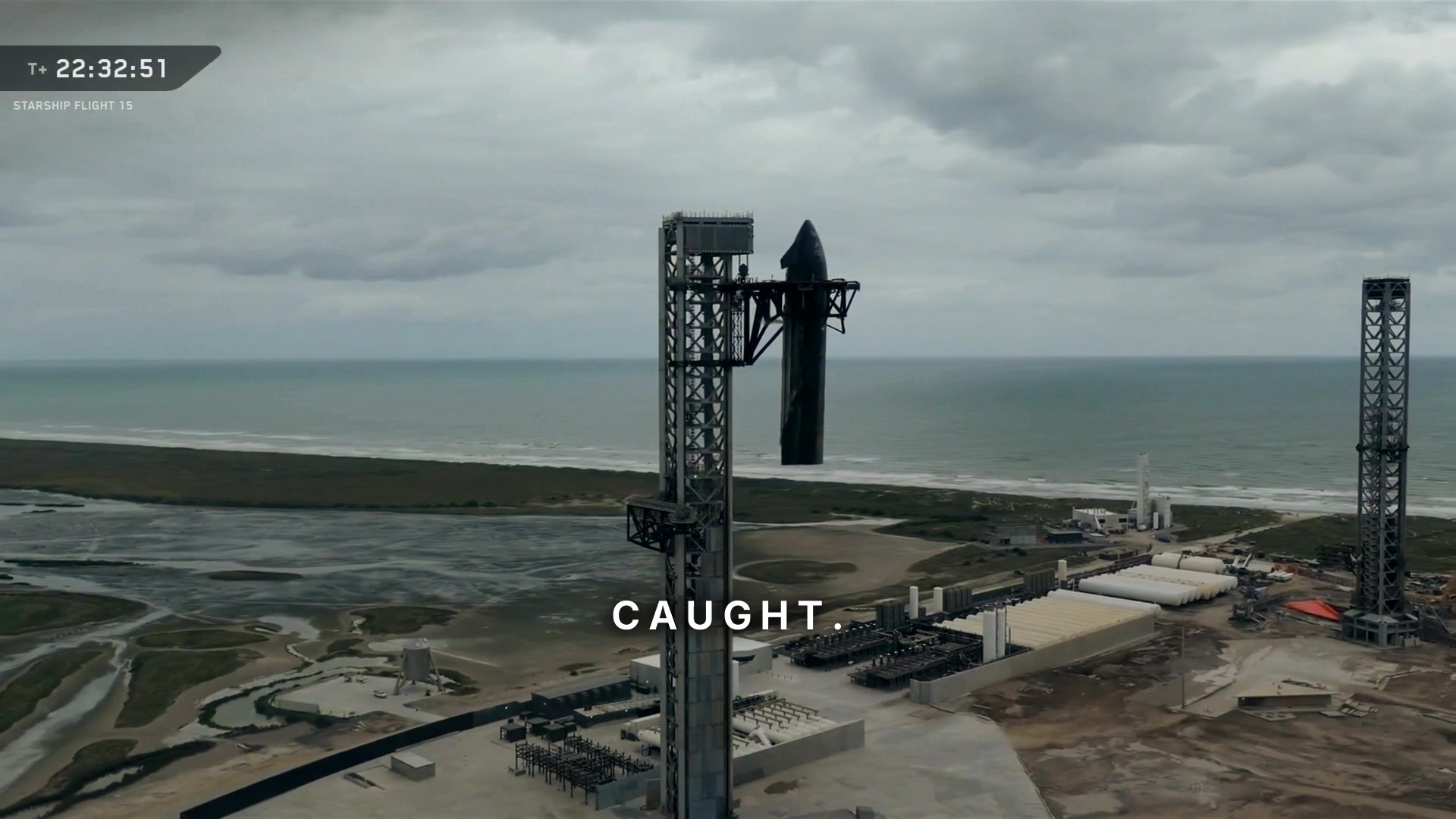
It then spent about 22 hours in space. On Saturday the ship relit a sea-level Raptor for its deorbit burn, came back over the Texas coast, and, in SpaceX's words, "three Raptor engines ignited for a landing flip and slow descent into Mechazilla's waiting arms." At 4:21 p.m. ET (1:21 p.m. PT), SpaceX posted: "Mechazilla catches Starship!" It was the first time a Starship upper stage had been caught. Elon Musk's summary that evening: "Three booster catches and a ship."
Booster 22
The booster didn't come back. According to SpaceX's Flight 15 page, Booster 22 relit 32 of its 33 engines for boostback, and the burn "ended early due to low fuel mass, with the root cause under investigation." Its guidance system triggered an automated abort during coast and diverted it offshore. It flew a landing burn with the engines cutting off while hovering over the Gulf, and "upon landing burn shutdown, the Super Heavy's flight termination system was triggered."
Musk wrote that slight underperformance of the engines was the reason, and that the fix is better engine performance and consistency, already underway with Raptor V3.2, plus a flight software change to cut the main engines about one second earlier. He added that "initial conclusions are often wrong to some degree" and that a full review of the telemetry is needed.
What SpaceX says comes next
SpaceX has not set a date for Flight 16. Musk wrote on Saturday: "We have the next booster almost ready for flight, but losing the tower or launch mount would potentially cost us 2 to 3 months." He also said "this booster loss does not change our timeline to reach high volume, fully reusable Starship flights," and that "future Starship flights will carry over 50 Tb/s of Starlink bandwidth to orbit."
Catching a booster and a ship on the same flight is still ahead. After 15 flights, does Saturday's catch settle the argument over SpaceX's fly-and-break approach, or does it only count once both stages come home together?
— Alex R
Sources: SpaceX, Flight 1 page; Flight 2 page and hot staging post; Flight 3 page; Flight 4 page; Flight 5 page and "On our first try, Mechazilla caught the booster"; Flight 6 page; Flight 7 page and "huge block of upgrades" post; Flight 8 page; Flight 9 page; Flight 10 page; Flight 11 page; Flight 12 page; Flight 13 page (the intact-heatshield wording is on this page) and a Flight 13 banking-maneuver post; Flight 14 page; Flight 15 page (post-flight recap, including the Booster 22 account); Flight 15 liftoff, payload deploy complete, "Mechazilla catches Starship!"; Elon Musk, "Three booster catches and a ship"; booster explanation and timeline, caveat, next booster, over 50 Tb/s. Video: SpaceX. Music: "Aphelion" by Scott Buckley (CC BY 4.0).