SpaceX · Starship · 23 Oct 2026
NASA's safety panel says one Starship Moon landing needs about 22 launches. Musk says 6 to 8. Here's the math behind both numbers
A member of NASA's Aerospace Safety Advisory Panel said on Thursday that the latest estimate for refueling SpaceX's Starship Moon lander is "around 22" launches. Elon Musk replied a few hours later: "That's way too high. Actual number will be more like 6 to 8." That's a gap of roughly three to one, and it matters, because every one of those launches has to happen before astronauts can land. Here's what each number implies about every tanker flight, and how long each one takes to fly.
On this page

What was said
NASA's Aerospace Safety Advisory Panel, an independent group that advises the agency on safety, held its quarterly meeting on Thursday, Oct. 22. Panel member Charlie Precourt, a former NASA astronaut, was talking about risks to the Artemis program when he raised the lander. "With respect to Artemis IV, however, we've got a large number of firsts that reduce the likelihood of mission success," he said, according to Ars Technica's report on the meeting. "We need to keep our eyes on numerous required fuelings for the lander. I think the last estimate is around 22 flights."
Precourt didn't name Starship, but Ars notes that NASA's other crewed lander, Blue Origin's Blue Moon, won't use orbital refueling in its initial mission design. Ars senior space editor Eric Berger posted the figure on X at .
Just now, on the Aerospace Safety Advisory Panel call, member Charlie Precourt said the latest estimate for refuelings needed to support a Starship landing on the Moon is "around 22" launches.
— Eric Berger (@SciGuySpace) October 22, 2026
Musk replied directly to that post at . His reply had been viewed more than 600,000 times by Friday morning.
@SciGuySpace That’s way too high. Actual number will be more like 6 to 8.
— Elon Musk (@elonmusk) October 22, 2026
Neither number is a test result. Ship-to-ship propellant transfer between two Starships has not been demonstrated yet. Gwynne Shotwell said on SpaceX's earnings call this week that the first attempt should come early next year, which, as we covered on Wednesday, is a date that has already slipped twice.
Why the lander needs refueling at all
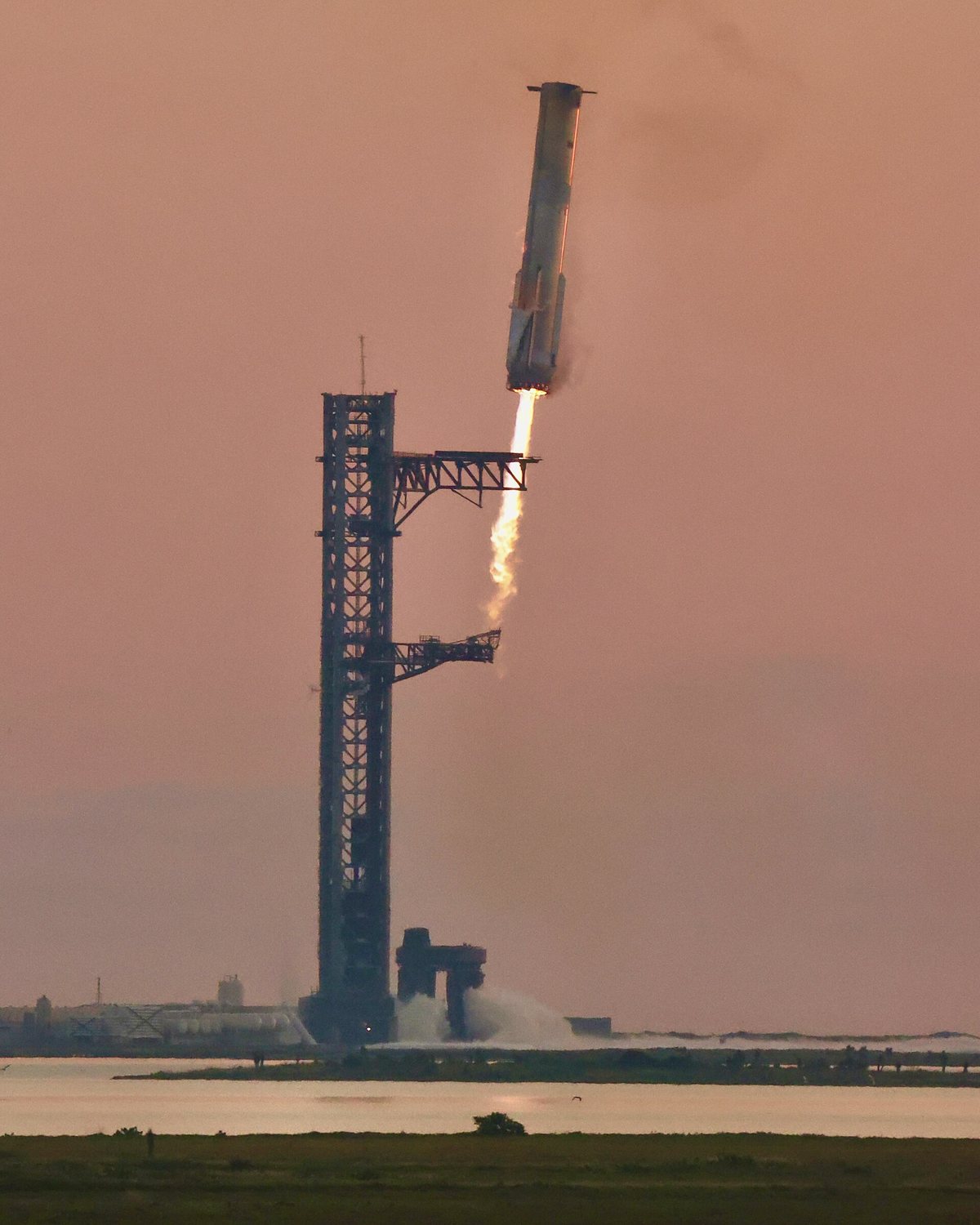
SpaceX's plan, laid out on its Moon mission page, uses three kinds of Starship. A depot ship sits in low Earth orbit and has bigger tanks than a normal Starship. Tankers, which are standard Starships with docking probes, launch one after another and deliver propellant to the depot. The lander then fills up and flies to the Moon. SpaceX says refilling in orbit lets Starship deliver "up to 100 tons directly to the lunar surface."
So the refueling count is really a question of two things: how much propellant the lander needs, and how much each tanker can actually hand over once it reaches orbit.
What each number implies per tanker
NASA and SpaceX haven't published how much propellant the depot must hold. What SpaceX does publish, on its Starship specifications page, is a ship propellant capacity of 1,600 metric tons of liquid methane and oxygen, plus a payload capacity of "100+ t" to orbit. If we use a full ship's worth of propellant as a rough stand-in for the job, here's what each estimate implies each flight has to deliver. This is our own arithmetic, for illustration only.
| Estimate | Launches | Propellant per launch to move 1,600 t | vs. Starship's listed 100+ t payload |
|---|---|---|---|
| NASA safety panel (Precourt) | ~22 | about 73 t | Below today's listing, which leaves room for boil-off and transfer losses |
| Musk, high end | 8 | 200 t | Roughly double today's listing |
| Musk, low end | 6 | about 267 t | Nearly triple today's listing |
That's the heart of the disagreement. NASA's figure looks like a number built on the Starship that flies today, with margin for propellant that boils away while the depot waits in orbit. Ars makes the same point: NASA "can take the current performance of the lift capacity of Starship and determine the mass of propellant needed." On this rough measure, Musk's figure only works if each tanker carries far more than the current version can.
That bigger version is what Musk calls Starship 4, or V4. He hasn't published a payload figure for it, but he has said it should enable "over 2M tons/year to orbit" and aims for about 10,000 metric tons of liftoff thrust, roughly three times a Saturn V. Those are design goals, not flown hardware.
One caveat cuts the other way. SpaceX says depot tanks have "increased volume" compared with a standard ship, so the real fill could be bigger than 1,600 tons. In that case every row above would need even more per launch.
How long each one takes to fly
The count matters mostly because of time. Every tanker has to launch while the depot holds its propellant cold, and SpaceX has given only targets for cadence: Musk said on the earnings call that Starship should fly weekly at some point in the first half of 2027, and twice weekly or more by the end of 2027.
| Launches needed | At one a week (H1 2027 target) | At two a week (end-2027 target) |
|---|---|---|
| ~22 (safety panel) | about 22 weeks, or 5 months | about 11 weeks |
| 6 to 8 (Musk) | 6 to 8 weeks | 3 to 4 weeks |
Ars reached a similar conclusion, estimating that even at "twice weekly" it would take about three months to fuel a depot at NASA's count. For comparison, SpaceX has averaged roughly one Starship flight every two months in 2026, so both rows are still well ahead of today's pace.
How the number has moved
NASA has been cagey about this figure for years. In 2023, the then-director of NASA's Human Landing System program, Lisa Watson-Morgan, told Ars, "We have a general idea, but I'm reluctant to say exactly what that is." She later described it as "high single digits to the low double digits," and other officials have said "high teens." Thursday's "around 22" is higher than any of those earlier ranges.
The timing matters too. Under the plan Space.com laid out in May, Artemis III in mid-2027 is a docking test with the Orion capsule in low Earth orbit, and Artemis IV in late 2028 is the landing near the lunar south pole. Both Starship and Blue Moon were still in the running for those missions. Precourt himself praised NASA Administrator Jared Isaacman's team for trying "to look for places where there are barriers" to help both landers succeed.
My read
Both men can be right about different rockets. Twenty-two is roughly what you'd expect from today's Starship with conservative margins. Six to eight is roughly what you'd get from a much bigger Starship 4 with good transfer efficiency. So the real question isn't who has the right number. It's which Starship will be flying tankers in 2028. Three things will settle it: the first ship-to-ship transfer test, how much propellant that test loses along the way, and whether SpaceX publishes a real payload figure for the next version. Until then, I'd treat Musk's 6 to 8 as a goal and NASA's 22 as the planning number.
Starship's next flight, Flight 15, is set for no earlier than Sun 8 Nov. Our Starship tracker has the countdown, and you can check whether the climb might be visible from your town on Can I see the launch?
Sources: Ars Technica (Eric Berger), 22 Oct 2026; @SciGuySpace on X (22 Oct 2026); @elonmusk on X (22 Oct 2026); @elonmusk on X (25 Aug 2026); @elonmusk on X (3 May 2026); SpaceX Starship specifications; SpaceX Moon page; Space.com (28 May 2026); NASA Aerospace Safety Advisory Panel; Supercharged Daily (21 Oct 2026). Per-launch and timeline figures are Supercharged Daily calculations.
— Alex R