Tesla · Roadster · 20 Oct 2026
Fans, thrusters and Optimus legs: Tesla's Roadster engineer takes Hagerty under the skin
Tesla VP of Vehicle Engineering Lars Moravy gave Hagerty's Henry Catchpole a 27-minute walk-around of the new Roadster before the reveal. The headlines: a rear-drive powertrain of over a megawatt, a fan-powered "sucker" system, a rear wing moved by Optimus leg actuators, and nitrogen cold-gas thrusters built with SpaceX. Here's what he said, and which parts are still targets.
Rear-wheel drive, and more than a Plaid
The new Roadster sends all of its power to the rear wheels. It has two rear motors, each with its own inverter, and together they make over 1 MW and 1,400 Nm. Moravy put it in Tesla terms: the pair has "more power and more torque than the three motors combined in a Plaid", packed into what he called "a super tight package." The separate inverters, he said, add "a little bit of redundancy" and make sure "each motor gets its own power." He hinted there's more to say about the inverters but held it back: "Gotta save some secrets."
The battery runs in the roughly 800-volt range Tesla uses on Cybertruck and Semi. Moravy described coolant flowing through the pack in one direction, from cold to hot, to keep the heat even, instead of the back-and-forth layout in many Tesla packs. Hagerty reports a claimed range of over 300 miles and a charging target of 15–80% in about 10 minutes. Tesla hasn't given the pack size. Moravy's pitch for the fast charging was track days: "25 to 30 minutes of unlimited track performance," then recharge and go again.
Weight is a ballpark of just under 1,700 kg. Moravy gave that as a target, not a final figure.
Chassis and active aero
The suspension is traditional supercar hardware: double wishbones and rocker arms at the front, a multi-link rear on a subframe with the motors and a planetary gearset. Hagerty says the adaptive dampers and track mode drop the car 40 mm and make it three times stiffer. The prototype body is all carbon fibre, though Hagerty notes some production panels may be metal.
Much of the bodywork moves. The headlights are about 15 mm thin and drop down rather than pop up. "The popdown is kind of cooler," Moravy said. A chin section hides wings whose leading edges move up to 80 degrees. The side panels behind the front wheels are barge boards that swing out. "Every little hill that looks like it doesn't know, it does know," he joked. At high speed, he said, the system can make about two g of downforce, at "over two hundred miles per hour".
The "sucker" system
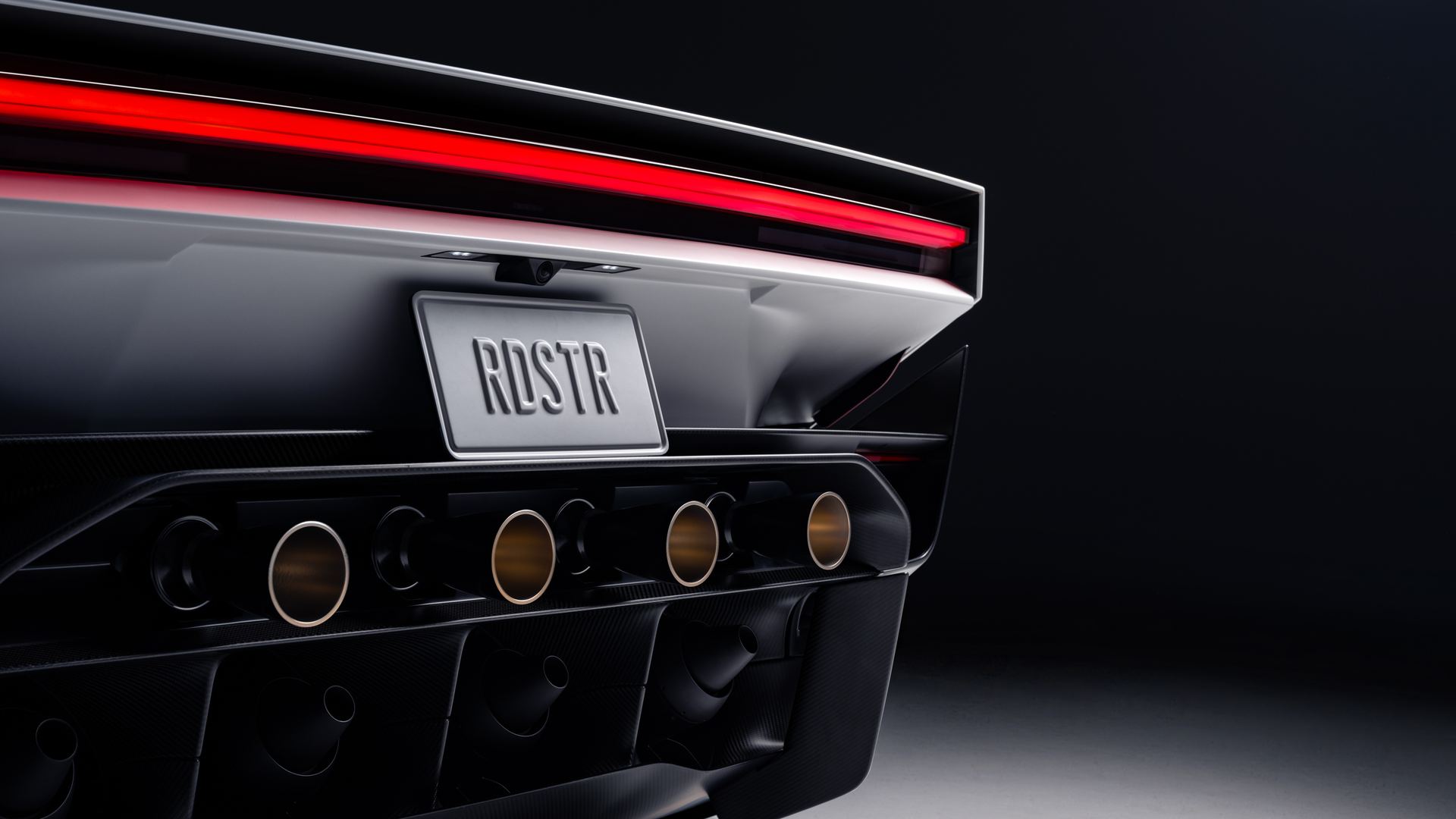
Wings don't do much below about 50 mph, so the Roadster has four fans at the rear. Moravy said they're based on the high-voltage compressor motor in Tesla's heat pump, at "maybe 20 kilowatts" each against 12 kW for the standard compressor. Four separate skirts drop to seal the car to the road. The idea is to get past the grip limit of rubber, which he said doesn't go "much above one" mu. In this mode he said the car can "hold over two G's in a corner" at low speed. At over 200 mph the front and rear skirts open for a high-flow mode that he said makes "an active wing, even more active." Hagerty says the skirts are replaceable rubber-and-nylon parts.
A wing moved by Optimus legs
The rear wing takes "thousands of newtons of force," so Tesla needed strong actuators. "These are actually the leg actuators from Optimus," Moravy said, with an added brake so they can hold position. The wing switches between high-downforce and low-drag modes. Asked about simulated laps of the Nürburgring, he wouldn't give a time.
The SpaceX part: cold gas
Behind orange-tinted titanium-oxide glass sits a 200-litre carbon-overwrapped pressure vessel (COPV) that holds nitrogen at up to 10,000 psi. It feeds cold-gas thrusters at the back. Moravy said they produce "over 80 kilonewtons of thrust," which is "about the same as like a typical fighter jet," with a single engine. A valve driven by an Optimus actuator releases the gas, and left and right nozzles can be trimmed for straight-line stability.
Why nitrogen? "It just seemed wrong to put fuel in the car," he said, and "80 percent of the air is nitrogen, so it didn't seem so bad." It's the same idea spacecraft use to adjust their position. Because the thrust comes from pressure alone, it fades as the tank empties. That's why the tank pressure is so high. Hagerty says a full refill of 600 litres takes six to seven hours today and isn't something you'd do at home. Tesla is working to cut that to about half an hour, but that's a goal.
Moravy was clear about who built what. The battery, powertrain, chassis, body, doors, seats and the sucker system are "all us," meaning Tesla. The thrust and flight packages were "joint development" with SpaceX, and the valve design is "very much a SpaceX thing."
Three versions
- Performance: fans, no thrusters. 0–60 mph in under 1.6 s (Tesla). Hagerty says the top speed is 210 mph. Hagerty also says a cheaper base model is still in development.
- Thrust: adds the rear cold-gas thrusters. Under 0.9 s per Tesla; Hagerty quotes 0.85 s. Hagerty says 230 mph.
- Rocket: adds a 400-litre tank (600 litres in total) and six more thrusters, one at each corner and two at the sides (Hagerty). It's a single-seater. Tesla lists under 0.59 s. Moravy said "point five five seconds" on camera, but that's a rollout figure, and Catchpole suggests adding "a tenth or two."
Those times are Tesla's claims. None has been independently tested yet.
Inside
It's a two-seater now, not the 2+2 promised in 2017. The seat bases are fixed, like a McLaren W1, with a movable pedal box and backs that recline. There are removable roof panels, a centre screen angled at the driver, steer-by-wire and brake-by-wire, and a yoke.
Pledged vs done
- Done: a public reveal, working prototypes, and reservations open on tesla.com/roadster (for the Performance version, $5,000 plus $45,000 within 10 days, $50,000 in total, per Engadget). Moravy said there were "about four or five prototypes" at the event for development.
- Pledged: production in 2028 (a target Musk gave at the reveal, per CNBC, not a commitment), a larger prototype build "early part of next year," roughly half-hour nitrogen refills, and the final weight, range and charging figures. Prices haven't been set.
My read
Catchpole's verdict is worth hearing. He says electric hypercars mostly haven't sold because a battery alone isn't enough to replace a V12. The Roadster, he argues, offers "something extra that you can't get anywhere else." He also admits he can't see how the flying version "is ever going to go on sale." That's the right tension. The fans, the Optimus-actuated wing and the 800 V powertrain are engineering Tesla already knows how to build. The thrusters are the moonshot. 2028 is the date to watch, and Tesla's earlier Roadster dates have slipped before.
Sources: Hagerty, "The FLYING Tesla Roadster explained by the man who engineered it" (YouTube, 16 Oct 2026); Hagerty video page; Tesla Roadster page (0–60 claims); Engadget (reservations); CNBC (2028 target). Video thumbnail used for sharing: Hagerty / YouTube. The quotes are from the video. Performance figures are Tesla's claims, not independent test results.
— Alex R