Tesla · 15 Oct 2026
Roadster day: Musk promises a “BANGER” tonight. Here is what that could mean, and the physics of rocket thrusters on a car
Elon Musk has called tonight’s Roadster demo a candidate for the greatest product demo of all time. If the SpaceX cold-gas thruster package shows up, the most interesting engineering will be hidden in a tank where the back seats used to be.
Update, 16 Oct 2026: Tesla has now revealed the Roadster. Read what happened, with the full replay →
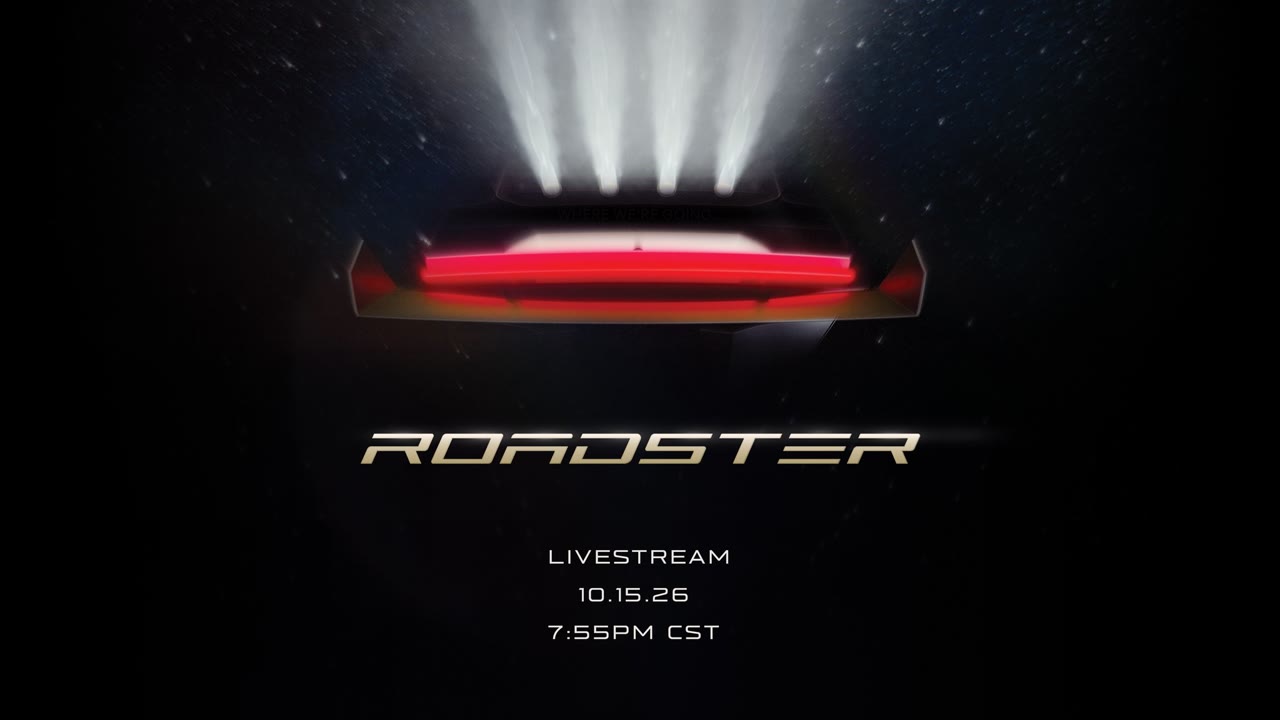
Tesla’s new Roadster finally gets its moment tonight. The company’s livestream starts at 7:55pm Central, which is 8:55pm ET, 5:55pm PT and 1:55am Friday in Ireland and the UK. Tesla announced the time on X on Tuesday, after high winds pushed the outdoor demo back from 1 October.
In the hours since, Musk has been turning up the volume. Just before 3am Irish time he wrote that the new Roadster “is a candidate for greatest product demo of all time”, a post that passed 22 million views by Thursday morning. Under 90 minutes later he added that the demo would be “a BANGER, probably metaphorically, though some chance literally.”
What “BANGER” could mean
The first reading is the obvious one. In internet slang, a banger is a hit, something everyone talks about. That is the “metaphorically” half, and it fits a CEO hyping his own launch.
The “literally” half is the more interesting one. A literal bang suggests something loud, such as a sonic crack from a car accelerating hard or, more plausibly, the sharp report of gas venting from a high-pressure nozzle. Cold-gas thrusters are not quiet. Open a valve on air stored at thousands of psi and you get a loud hiss-crack and a white plume as the gas expands and cools. If Tesla fires the SpaceX package in front of a crowd, “bang” is a fair description.
There is also a darker joke in it. With live hardware, a real bang is always possible. Musk has a habit of saying this out loud before risky demos. It is worth remembering the Cybertruck “armour glass” moment in 2019, when a steel ball cracked two windows on stage. Our read: “some chance literally” is Musk signalling that something will fire, and that it is not a scripted animation. That is our interpretation, not a Tesla statement.
The promise on the table
The SpaceX option dates back to June 2018. Musk wrote then that it would add “~10 small rocket thrusters arranged seamlessly around car” to improve acceleration, braking and cornering, and joked that they might “even allow a Tesla to fly.” He later said the thrusters would run on ultra-high-pressure air stored in a SpaceX composite overwrapped pressure vessel, or COPV, in place of the rear seats, and topped up by an electric pump. In 2021 he confirmed a target of about 1.1 seconds for 0–60 mph, roughly 2.5g of average acceleration. Tesla has not confirmed that any of this will appear tonight.
How a cold-gas thruster works
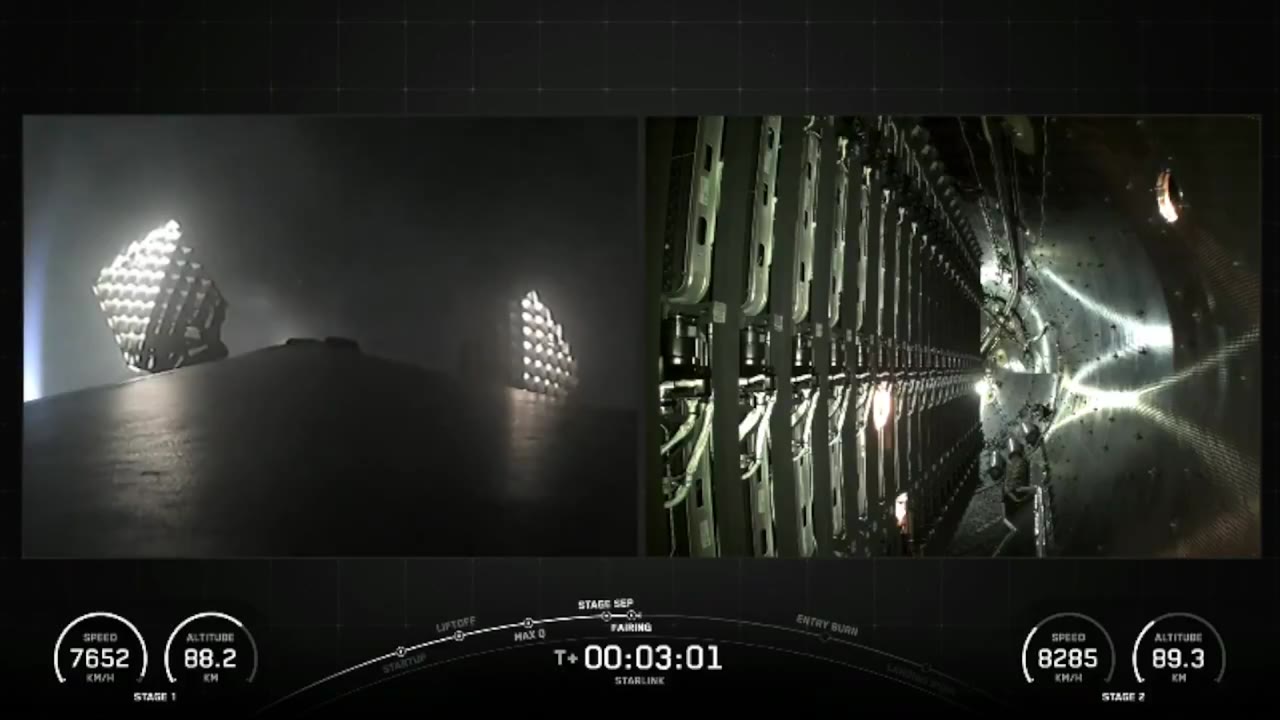
It is the simplest rocket there is. A tank of compressed gas feeds a valve, the valve feeds a nozzle, and nothing burns. When the valve opens, gas rushes out one way and the vehicle is pushed the other way. That is Newton’s third law and nothing more. Because there is no combustion, the thruster can fire in milliseconds, as often as needed, and leaves no soot or flame. Falcon 9 boosters use nitrogen thrusters of exactly this kind to flip themselves around after stage separation, where the air is too thin for the grid fins to grip. The full SpaceX video of that flip is embedded below.
The catch is energy. A tank of compressed air holds far less energy than a battery or a tank of fuel of similar size. That is why any thruster boost would come in short bursts: a launch, a hard stop or a corner. It would not be a sustained hover.
The pressures involved
Tesla has never published the pressure its tank would run at, so we will not guess a number. But the hardware Musk named gives a sense of scale. The helium COPVs inside a Falcon 9 second stage run at about 5,500 psi in flight, according to SpaceX’s Amos-6 investigation reporting (Spaceflight Now). That is roughly 375 times atmospheric pressure. For everyday comparison, a car tyre runs at around 35 psi, so a rocket-grade COPV holds more than 150 times the pressure of the tyre you drive on.
Road cars already carry tanks like this. Hydrogen fuel-cell cars such as the Toyota Mirai store hydrogen at 700 bar, about 10,000 psi, in carbon-fibre-wrapped tanks that have to pass crash, fire and bonfire tests before they are allowed on the road. So the idea of a carbon-wrapped high-pressure tank in a car is not new. Using it as a thrust source is.
What if a tank ruptured?
This is the safety question every engineer will ask tonight. Compressed gas stores energy in the pressure itself. If a vessel fails suddenly, that energy is released all at once as a blast wave, and broken pieces can become projectiles. Air is not flammable, which is a real advantage over hydrogen or rocket propellants: there is no fireball. But a sudden failure of a large tank at thousands of psi would still be violent.
SpaceX knows this better than anyone. In September 2016 a Falcon 9 was destroyed on the pad before the Amos-6 mission. The investigation traced the cause to a failure in one of three COPVs inside the second-stage liquid-oxygen tank. Super-chilled oxygen had become trapped in buckles between the aluminium liner and the carbon overwrap, then ignited. SpaceX said only 93 milliseconds passed between the first sign of trouble and loss of data. The fix was warmer helium loading and a redesigned COPV.
Two points matter for a car. First, the Amos-6 failure involved cryogenic oxygen, a condition that would not exist in an air tank sitting in a Roadster. Second, composite tanks are designed with large safety margins, and automotive hydrogen tanks show they can be certified for crashes. In theory a Roadster tank would be engineered, like those, to leak or vent in a controlled way rather than burst. How Tesla handles crash protection, overpressure relief and refilling will tell us whether the package is a road product or a show piece.
Speculation: what we could see tonight
Best case, Tesla fires the thrusters on a closed course and shows a launch under 1.5 seconds, plus a braking or cornering demo. A literal “bang” would fit that. A short hop would be the ultimate stunt, but it is the least likely, given how little energy a tank of air holds. Worst case, the SpaceX package is mentioned but not shown, and the night is about the base car’s price, range and delivery date.
The full source video
Below is SpaceX’s own footage of a Falcon 9 booster flipping after stage separation, with the nitrogen cold-gas thrusters visible as white puffs. Credit: @SpaceX.
Falcon 9 stage separation and flip
— SpaceX (@SpaceX) View the post on X
Tesla’s announcement of tonight’s stream, and Musk’s two posts:
Roadster event streaming live this Thursday at 7:55pm CST
— Tesla (@Tesla) View the post on X
Let’s just say that this demo will be a BANGER, probably metaphorically, though some chance literally
— Elon Musk (@elonmusk) View the post on X
What happens next
Watch for four things tonight: a measured 0–60 time, the price, a delivery date and any live thruster firing. More background: the livestream time, Musk’s cold-gas thruster promise and how Falcon 9 uses the same idea.
If Musk is right, tonight is either the best demo in automotive history or the loudest one. I’ll be up at 1:55am to find out.
— @AlJR86